 Awards of
World War II
Awards of
World War IIThe award was originally called the Order of Merit of the German Eagle and was established by Adolf Hitler on May 1, 1937, as an award for representatives of other countries who had distinguished themselves in the service of Germany.
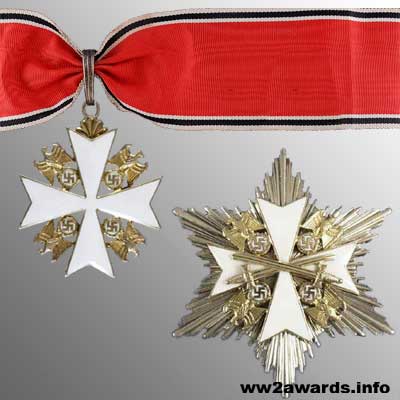
Initially, the award was intended only for civilians, but on April 20, 1939, its regulations were amended to include military personnel, in which case the degree of the order would be supplemented with crossed swords. The first award of the highest degree of the order took place on September 25, 1937, when Benito Musolini, leader of the Italian Fascists, received the award. The award for such an important occasion was encrusted with diamonds.
During its existence, the order underwent several statutory changes. Initially, the award had five degrees, similar to orders of other countries: Grand Cross, Grand Commander's Cross (Order with Star), Commander's Cross (Order First Class), Officer's Cross (Order Second Class), and Knight's Cross (Order Third Class). It had no statute; all awards were made in accordance with the so-called instructions. One of the clauses of this instruction stated, "All consuls and diplomats who have served at least two years in the diplomatic missions of their embassies in Germany are awarded the corresponding degree of the Order of the German Eagle upon their return to their homeland upon completion of their service."
This instruction was supplemented in 1938, and the order received its full statute only on April 20, 1939. The final statute provided for the highest degree of the order – the Grand Cross of the Order of the German Eagle in Gold, a limited award granted to only 16 individuals. This award was received by Ion Antonescu (Romanian Marshal), Hiroshi Oshima (Japanese Ambassador) in Berlin, Karl Monnerheim (Finnish Marshal), Ryti Hyki Risto (Finnish President), Miklós Horthy (Hungarian Admiral), Boris III (Tsar of Bulgaria), Francisco Franco (Generalissimo of Spain), and Count Galezzo Ciano (Italian Foreign Minister). The award of the two highest degrees of the order (Grand Cross and with Star) was made by a special decree signed by Hitler, the Chief of the Order's Chancellery, and the Foreign Minister. The lower degrees of the order were awarded by decree signed only by the Reich Minister. In addition to the order, recipients received a certificate containing an excerpt from the award order, signed by the head of the order's chancery.
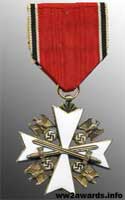
In the event of awarding a higher degree of the order, the lower degree of the order had to be surrendered to the order's chancery. In the event of the death of the recipient, the award remained with their heirs as a commemorative token.
Initially, in accordance with the statute, only foreign citizens who did not hold German citizenship could be awarded the order. The Foreign Ministry objected to this provision of the statute, declaring that an award not worn by any German official would not be valued in other countries. Following this, the Reich Foreign Minister began wearing it at ceremonial events, and after 1939, the Protector of Bohemia and Moravia, too. But they were not knights of this order, so when Konstantin von Neirath handed over his cabinet to Joachim von Ribbentrop in February 1938, he also handed over the Order of the German Eagle.
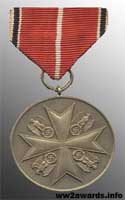
By a special decree of December 27, 1943, significant changes were once again made to the order's statutes. The degrees of the order became classes, and the number of variants of the order reached nineteen: the Grand Cross of the Order of the German Eagle set with diamonds (awarded only to Mussolini), all subsequent awards have two varieties (with and without swords), the Grand Cross of the Order of the German Eagle in Gold, the Grand Cross of the Order of the German Eagle, the Order of the German Eagle 1st, 2nd, 3rd, 4th, 5th class, the German Medal of Merit in silver, and the German Medal of Merit in bronze.
The award is in the shape of a Maltese cross, enameled with white enamel. For the sword version, two crossed swords were superimposed on the cross. Between the arms of the order is an imperial eagle with folded wings, the eagle's heads turned to the left (counterclockwise). The eagle sits on a laurel wreath encircling a swastika. If the degree of the order required it to be worn on a ribbon, the reverse of the award had the same embossing as the obverse. For a chest award, the reverse was plain and had a pin for attaching to clothing. The Order of the German Eagle was made of silver, with the highest degrees made of gilded silver.