 Awards of
World War II
Awards of
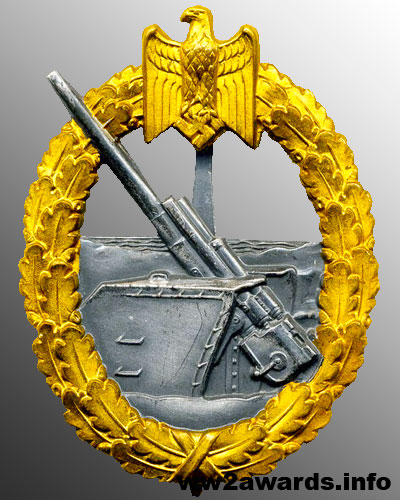
World War IIThe award was established by Grossadmiral Erich Raeder on June 24, 1941, as a breast badge for coastal and naval artillery.
Initially, the criteria for receiving the award were somewhat vague, and looked like this:
- For a high level of troop command;
- For an individual act of heroism or combat merit for which no other awards are provided;
- For death in the line of duty;
On January 28, 1942, the regulations for the Naval Artillery breast badge were supplemented with a points system specifying the merits for which it is awarded; in total, it was necessary to collect 8 points.
2 points - for an aircraft shot down without fire support;
1 point - for an aircraft shot down by several fire crews;
0.5 points - for the detection of an aircraft by a searchlight crew;
0.5 points - for radio interception of enemy aircraft or ships;
0.5 points - for a hit with a large-caliber gun;
0.5 points - for skillful control of gun fire.
The design of the badge was developed by the German artist Otto Placzek. The badge was made of zinc, oval in shape, and measured 53 x 41 mm.
This badge, like others similar to it, is shaped like a wreath of oak leaves, entwined at the bottom with a ribbon. At the top is an eagle with folded wings, holding a swastika in its talons. In the center of the wreath is a coastal gun against a backdrop of sea waves, the gun's barrel extending beyond the wreath.
The reverse features a vertical pin for attaching the badge to clothing and the manufacturer's stamp. Known variants include: FLL, Hermann Aurich, Juncker, and Berlin.
This badge was worn on the left side immediately below the Iron Cross 1st Class or equivalent award.
A total of approximately 6,400 Kriegsmarine Artillery badges were awarded.