 Awards of
World War II
Awards of
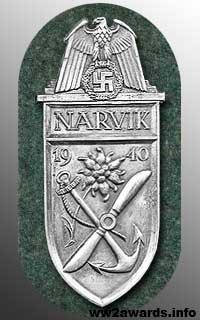
World War IIThe award was created to recognize all soldiers who fought in the Battle of Narvik, both on land, at sea and in the air, from 9 April 1940 to 9 June 1940. The Narvik Shield is a medallion worn on a patch below the shoulder on the left sleeve.
Materials
zinc, gold-plated, silver-plated.
Dimensions
92*41 mm without backing.
Designer
Richard Klein.
The Narvik Shield was instituted on March 21, 1941. The first recipient was Colonel General Eduard Dietl, and the award ceremony was conducted by Adolf Hitler personally. The criterion for awarding the shield was participation in the Battle of Narvik in any branch of the armed forces between April 9, 1940, and June 9, 1940. A total of 8,577 people were awarded this shield.
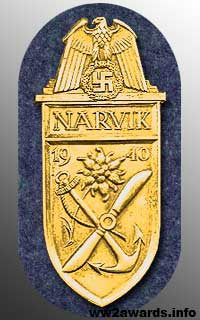
The award is shaped like a shield, above which is an eagle with its wings down, perched on a wreath bearing a swastika. In the center of the shield is a crossed propeller and anchor, with an edelweiss flower visible at the top intersection. This composition symbolizes the unity of the various branches of the armed forces: the Air Force, the Navy, and the mountain riflemen. On either side of the edelweiss flower are the numbers "19" and "40," with the inscription "NARVIK" above.
The shield was produced in two versions: gold for the Kriegsmarine and silver for the Luftwaffe and infantry. The fabric backing of the Narvik shield also differed: blue for the Kriegsmarine, blue-gray for the Luftwaffe, and feldgrau for the infantry.
The Narvik shield is worn on the left sleeve, on the upper part, on both service and parade uniforms. If shields from other branches of the armed forces were present, both shields were permitted to be worn, one above the other. When wearing civilian clothing, a miniature replica of the award (size 16 mm) was permitted to be worn on the left lapel.
Narvik was one of the largest port cities in northern Norway, connected to the Norwegian mainland only by rail. A Reich force consisting of 10 destroyers, carrying mountain infantry units, advanced toward Narvik on April 6. After negotiations for the voluntary surrender of the city failed, a battle broke out between two Norwegian ships and the German fleet, in which both Norwegian vessels were sunk. The mountain infantry landing force then occupied Narvik and the surrounding area, but found itself cut off from supplies by the British Navy. Colonel General Dietl's troops were desperately short of ammunition and provisions to hold the line, and they were poorly prepared for combat in the freezing temperatures of the Arctic. By the end of May, the Allies had increased their advantage over the German forces to almost one-sixth: 26,000 to the Reich Army's 5,000, consisting of Jägers and sailors from sunken and damaged ships. On May 27, 1940, the Allied forces launched an offensive, pushing the German forces in Narvik back to the Swedish border. The situation in France saved the situation. The British government decided it needed to focus on defense and repelling the aggression of the Third Reich, and withdrew its troops from Narvik, literally saving Dietl's army from certain defeat. After Norway lost Allied support, it was unable to defend itself and capitulated on June 10. To honor Dietl's troops who fought in a near-stalemate, the Narvik Shield was established in March 1941, and it was awarded to all participants in the events described above.