 Awards of
World War II
Awards of
World War IIThe award was established on August 31, 1940 for officers and sailors serving on minesweepers, boats, and destroyers, and submarine hunters.
According to the award regulations, the criteria for receiving the award were as follows:
- Participation in at least three raids;
- Wound received during a raid;
- Successful completion of at least one operation;
- Rescue of people from a ship sunk during battle;
- Exemplary service for 180 days;
- Service on Mined areas;
- Performing escort ship functions for 25 days.
The first presentation took place on November 28, 1940. The total number of those awarded is unknown, but estimates place it at 4,300.
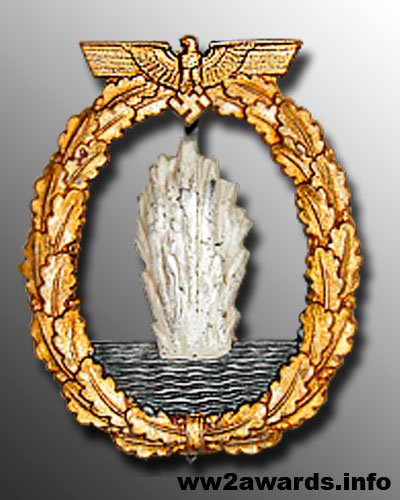
The award was originally made of brass with a silver coating; later badges were made of zinc. It is designed as a wreath of oak leaves, measuring 53 x 42 mm. At the bottom, the wreath is entwined with a ribbon, and at the top, an imperial eagle with outstretched wings, holding a swastika in its talons, is superimposed on the wreath. The center of the award depicts the sea and spray from a mine explosion. If the award was made of brass, the sea and spray were silvered. There is also information about a badge with a gilded wreath and nine diamonds, but no records of this award being awarded have survived. Furthermore, instead of the award, a similarly designed patch made on a dark blue piece of fabric was permitted.
On the reverse, the award has a vertical pin for attaching to clothing and may also bear the manufacturer's mark.
The award came with the usual set of documents indicating the recipient's name, unit name, signature, and stamp. This badge was worn on the left side immediately below the Iron Cross 1st Class or equivalent award.