 Awards of
World War II
Awards of
World War IIA separate award, the War Merit Cross, was created to recognize other significant merits that were not sufficient to merit the Iron Cross or the German Cross.
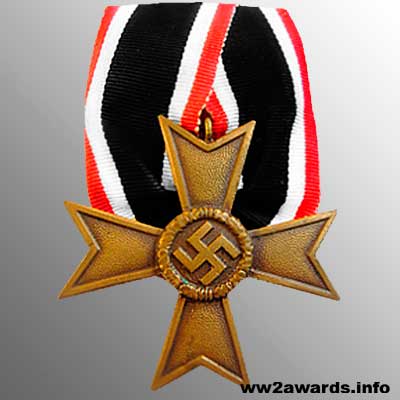
The award was established in honor of the anniversary of the Battle of Leipzing. Initially, the War Merit Cross had two classes, 1st and 2nd, and two varieties: with swords for military personnel and without swords for civilians. On August 19, 1940, two more classes of the award were established: the Knight's Cross and a medal. The final degree was the Knight's Cross in Gold, instituted on July 8, 1944. Similar awards had previously existed in Germany, but their names and forms varied across regions. A variant of the Iron Cross with a special ribbon, awarded for non-combat merit, also existed. Germany's participation in World War I and the Spanish Civil War demonstrated that such a single award, for both combat and non-combat merit, was insufficient. Furthermore, the widespread awarding of such a medal diminished the value of the order for military merit. When Hitler reinstated the Iron Cross in 1939, its non-combat version was not instituted, and it became a purely combat award. A separate award, the "War Merit Cross," was created to recognize other significant achievements that were not sufficient to merit the Iron Cross or the German Cross.
The War Merit Cross could be awarded to military personnel of all ranks. Civilians who assisted in combat operations but did not directly participate in them were also eligible for the award. Citizens of other countries were not, as a matter of principle, awarded this award. An exception was made for volunteers who had sworn allegiance to the Führer; they were treated equally with German soldiers and could receive this order like any other soldier of the Reich. Furthermore, this award could be presented to any enterprise that exceeded its military procurement plan. There were also several cases of awarding the War Merit Cross to transport ships.
Initially, the War Merit Cross was not worn when awarding the Iron Cross; this rule was abolished after September 1941.
The War Merit Cross became the most widely awarded decoration in the Third Reich, as it was awarded for many, even very minor, services among soldiers who had received the highest awards, such as the Iron Cross or German Cross. It was derisively called the Buffet Order or the Order of Service Evasion.
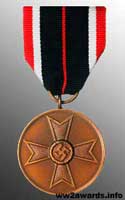
This award was established in August 1940 as a junior degree of the order. The introduction of this award into the Third Reich's award system was prompted by the widespread awarding of medals at the beginning of World War II. To maintain the award's prestige, a lower class, the War Merit Cross Medal, was created exclusively for civilians. It consists of a medallion with an image of the order without swords on the obverse and the inscription "For Military Merit 1939" on the reverse. The War Merit Cross medal is attached to a seven-stripe award ribbon with a loop and ring. A narrow red stripe divides the wide black stripe in the center, with a white and red stripe on either side of the black stripe.
Originally, the award was made of bronze, but the quality of the material deteriorated during the war, and the final awards were only bronze-plated.
Over the course of its existence, the medal has been awarded to more than 4,000,000 people.
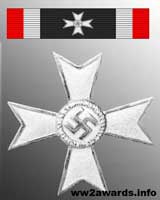
The Military Merit Cross, 2nd Class, without swords, was intended to be awarded to individuals who assisted the military but did not directly participate in military operations. Civilians who exceeded production quotas at factories and plants, as well as security and police personnel, met these criteria.
The Military Merit Cross, 2nd Class with Swords, was awarded to military personnel, primarily support and support personnel, who had performed a courageous or other significant act requiring recognition, but not in direct combat with the enemy.
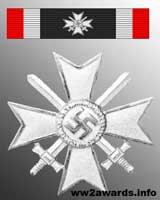
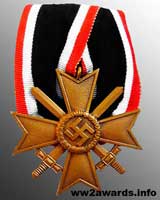
It was shaped like a Maltese cross measuring 49 x 49 mm. In its center was a circle framed by oak leaves, containing a swastika on the obverse and the founding year on the reverse.The "1939" edition. The rays were finished in a matte, shagreen finish and framed by a thin, smooth border. For the sword version of the order, two crossed swords are placed in the center of the cross's rays. An eyelet is soldered to the upper ray, through which a ring for the order's ribbon is threaded. The ribbon consists of a wide black stripe in the center and narrow white and red stripes at the edges. The award was originally made of bronze, but during heavy military operations the quality of the material deteriorated, and later versions of the award are made primarily of bronze-plated zinc.
In everyday life, only the order ribbon was worn, threaded through the second button; when awarded the Iron Cross, the ribbon was worn below its ribbon.
Over the years of its existence, 6,135,000 people were awarded the War Merit Cross 2nd Class with swords, and 1,591,567 without swords.
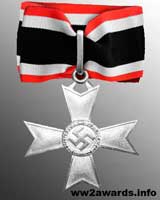
This award was awarded to individuals who, while performing auxiliary duties during military operations, demonstrated Bravery or a courageous act that had an impact on the course of military operations. This order was also awarded to defense industry factories that exceeded their production plans.
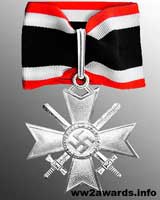
The obverse of the award was identical to the 2nd Class order, while the reverse was smooth and featured a pin for attaching to clothing, similar in design to the Iron Cross 1st Class. The award could also be made with a screw fastening, a design much favored by the military. Initially, the award was made of sterling silver, later of silver alloys, and by the end of the war, of silver-plated zinc.
During World War II, 484,000 awards of the War Merit Cross 1st Class with swords were made, and 90,000 without swords.
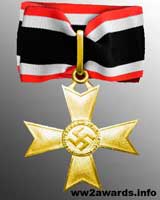
The award was established on August 19, 1940, and in terms of prestige, it took a place between the Knight's Cross of the Iron Cross and the German Cross in silver. To be eligible for the Knight's Cross of the War Merit Cross, one had to hold two of the order's junior awards. Like the first two classes, the Knight's Cross existed in two versions, with and without swords. In 1943, the Führer signed a decree excluding political figures from the award; it was decided to establish a separate award for them.
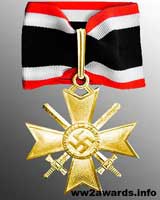
The Knight's Cross of the War Merit Cross was identical in shape to the second class award, differing only in its special fastening: an L-shaped structure surmounted by a ring was soldered to the upper arm. The version of the award without swords had a smooth L-shaped design, while the version with swords had two parallel lines on the surface. The award was also somewhat larger – 52 x 58 mm, compared to 49 x 49 mm for the lesser awards. It was made of 800-935 sterling silver.
The order was worn around the neck, attached to a ribbon consisting of a 22 mm-wide black stripe in the center and 4 mm-wide white and red stripes at the edges.
The exact number of recipients of the Knight's Cross of the Military Merit Cross remains unknown, as its recipients included engineers, scientists, and high-ranking spies. According to various sources, between 178 and 211 people received the Order with swords, and 48-52 without swords.
This award was the highest and last of the Order's awards, established on October 13, 1944. In the award system, it ranked below the Knight's Cross of the Iron Cross with Oak Leaves, but above the Knight's Cross of the Iron Cross itself.
This award was identical to the junior award, the Knight's Cross of War Merit; the only difference was the order's gilded surface. The first award was presented on Adolf Hitler's birthday in 1945. By the end of the war, only 21 people had become holders of the Knight's Cross of the War Merit Cross in Gold.
Knight's Cross of the War Merit Cross
With/without swords: silver "900" hallmark "1" - from 4,000 USD; silver "900" hallmark "20" - from 4,500 USD; silver-plated - from 1,100 USD
Document: Parchment in a leather folder - from 23,000 USD; Preliminary document - from 2,800 USD; Case - from 2,800 USD
1st degree
Without swords: tombac - from 180 USD; zinc - from 140 USD; on a screw - from 200 USD