 Awards of
World War II
Awards of
World War IIThe medal was intended to award those who fought on the Eastern Front during the first winter after the outbreak of war against the Soviet Union. Due to the high incidence of frostbite among German troops, it was nicknamed the Frozen Meat Medal.
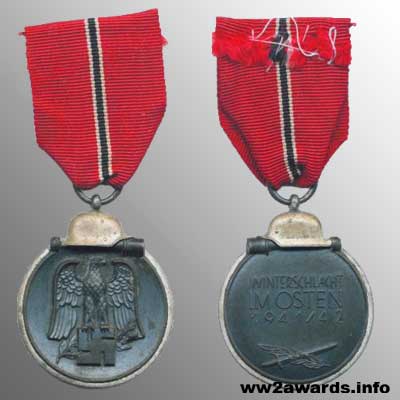
Materials: zinc, silver plated.
Dimensions: 44-36 mm.
Artist: Ernst Krause.
The award was established on May 26, 1942. To receive the medal "For the Winter Campaign in the East 1941-1942", it was necessary, between November 15, 1941 and April 26, 1942, on the Eastern Front:
The last award ceremony took place on September 4, 1944; in total, more than 3,000,000 people were awarded.
The award is made in the form of a circle with a diameter of 36 mm and is decorated with a hand grenade and A helmet, to which a ring for the award ribbon is attached. The medallion has a silver lining along the edge, as does the helmet. In the center of the medallion is an eagle with folded wings perched on a swastika, with a laurel branch in the background. [The medallion is missing a reference to the swastika.]
On the reverse of the medal is an inscription that translates as "WINTER CAMPAIGN IN THE EAST 1941/42." Below the inscription is a crossed sword and laurel branch. The medal's ribbon is red, with two white stripes and a black stripe in the center. The colors represent: Red – the blood of soldiers who fought in battle, white – the endless Russian snows, and black – the memory of fallen soldiers.
Winter was the coldest in 140 years. German soldiers were unprepared for the harsh Russian winter, and the troops suffered a huge number of frostbite cases of varying degrees. For this reason, this award was nicknamed the "Frozen Meat" medal.
Medal – from 30 USD; Document – from 30 USD; Package - from 15 USD
By mid-November 1941, Reich troops had completely occupied Belarus. In Ukraine, only Sevastopol remained unoccupied. Leningrad was blockaded in the north, and Army Group North advanced on Murmansk, but was stopped at the Zapadnaya Litsa River. Army Group Center stood on the approaches to Moscow.
After November 15, 1941, Army Group Center launched a major offensive aimed at capturing the USSR capital, Moscow, but by December 1, the offensive had stalled. On January 5, Soviet troops launched a counteroffensive, managing to push enemy forces back 100-250 km from Moscow. In January 1942, the Soviet command decided on a large-scale offensive in this direction, but the offensive failed to achieve its goal, and by April 1942, both armies, having suffered enormous losses in equipment and manpower, temporarily ceased active offensive operations.
In January 1942, the Soviet command launched the Barvenkovo-Lozovo Offensive Operation against German Army Group South. The operation succeeded in breaking through the front 100 km wide and advancing 90-100 km in depth, destroying significant enemy forces.