 Awards of
World War II
Awards of
World War IIThe medal was established to award members of the Wehrmacht, the SS, and the Austrian branch of the NSDAP who participated in the annexation of Austria, Adolf Hitler's homeland, to the Third Reich.
Materials
Copper, silver plated.
Dimensions
33 mm.
Artist
Richard Klein.
The award was established on May 1, 1938. The last award ceremony took place on December 13, 1940. During this time, a total of 318,689 people were awarded the Medal "In Memory of March 13, 1938".
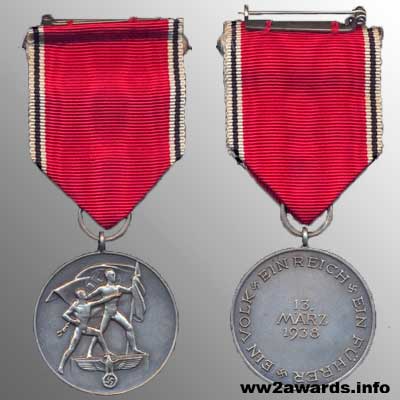
The round medallion has a diameter of 33 mm and was made of silver-plated copper. The reverse of the medal for the annexation of Austria is decorated with an allegorical scene. It depicts a man standing on a pedestal adorned with the Reich coat of arms, holding the flag of Nazi Germany. This man is helping another man ascend the pedestal. The people in this scene symbolize Germany and Austria, and the German people's assistance in bringing Austria back into the fold of the Third Reich.
The reverse of the medal is decorated with the inscription "MARCH 13, 1938" in the center, and the inscription "ONE PEOPLE, ONE STATE, ONE LEADER" around the circumference, divided into three parts by a swastika. The medal is attached with an eyelet and ring to a red award ribbon with thin, 1 mm wide stripes of white, black, and white along both edges.
Medal - from 60 USD; Document - from 40 USD; Case – from 50 USD
The conditions for the Anschluss of Austria were formed after the end of World War I, when the division of Austria-Hungary into different states left Austria virtually without resources or production capacity. The movement of German-speaking Austria toward unification with Germany was particularly strong in the immediate postwar years, but was artificially restrained by the victorious powers. In 1931, the two states attempted to create a single customs zone, but this initiative was also blocked by the victorious powers.
After Adolf Hitler came to power, the annexation of Austria became one of Germany's official policies. Within Austria itself, unification with Nazi Germany was not universally welcomed. In June 1933, the activities of the NSDAP were outlawed in the country.
In February 1938, the Austrian Chancellor, under threat of immediate military invasion, was forced to agree to terms under which Arthur Seyss, the leader of the Austrian Social Democrats, would become Chief of the Detective Police and Minister of the Interior, and Nazis convicted of various crimes would be amnestied.
In an attempt to prevent the Anschluss, in early March, the Chancellor attempted to call a referendum in which the only question was "Do the people desire a free and independent Austria?" and the only vote was "YES." But the referendum never took place. On March 11, under pressure, Chancellor Kurt von Schuschnigg resigned, announcing his resignation over the radio. He also ordered Austrian troops to hold fire and retreat if Reich troops entered Austria.
On the night of March 11-12, 1938, German troops entered Austria unopposed. On March 13, 1938, Adolf Hitler made his ceremonial entry into Vienna, the same day the Law on the Reunification of Austria with the German Empire was passed. On May 1, 1938, the medal "In Memory of March 13, 1938" was created to honor all those who participated in these events.