 Awards of
World War II
Awards of
World War IITo recognize all those who designed and built military fortifications on Germany's western border, the Atlantic Wall Medal was established.
Materials
up to 44 – tombac, after – zinc with bronze coating.
Dimensions
height 40 mm, width 33 mm.
The award was established on August 2, 1939, the last awarding ceremony took place on March 31, 1941, after which it was repeated Established on October 10, 1944 (the only time the award was reinstituted during a single war). During this time, the Atlantic Wall Medal was awarded to 622,064 military and civilian personnel.
The Atlantic Wall Medal, also known as the Atlantic Wall Medal, was established to honor the more than 600,000 engineers, designers, and builders who constructed the western wall on the German border. This medal was also awarded to military personnel who served on the Atlantic Wall until May 1940. Following the Allied landings in Normandy, the medal was reinstituted on October 10, 1944. Engineers and construction workers were sent to the Atlantic Wall to strengthen it.
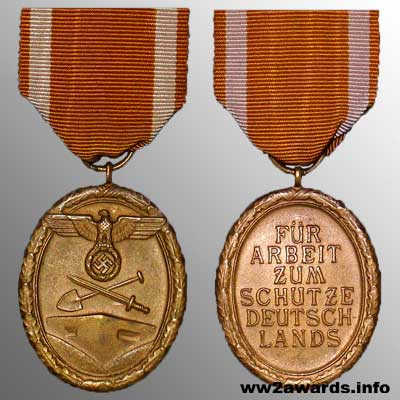
The Atlantic Wall Medal is oval. The obverse depicts a wall with two embrasures of different sizes, standing between hills, along the lower edge. Above the wall is a crossed spade and sword, symbolizing the award's intended use for both soldiers and workers. Above, an eagle with outstretched wings perched on a wreath with a swastika in the center. Along the outer edge, the medal is encircled on both sides by a wreath of oak leaves, bound by a ribbon at the top and bottom. On the reverse is the inscription, translated as "FOR WORK IN THE DEFENSE OF GERMANY." The medal is attached to a light brown ribbon with two white stripes near the edges using a loop and a ring. The medal was originally made of tombac, and after its reinstitution, due to Germany's dire situation, which was on the brink of defeat in the war, it was made of bronze-plated zinc.
It is also known that for those who received the award for the construction of the rampart in 1939-41, after its reinstitution, a repeat award bar with the date "1944" was instituted, but there is no information about awards with such a bar.
Tombac – from 35 USD; Zinc – from 20 USD; Document – from 20 USD; Case – from 100 USD; Package - from 10 USD
The defensive fortifications on Germany's western border, known as the Atlantic or West Wall, and nicknamed the Siegfried Line by the Reich's enemies, were constructed between 1936 and 1940. More than 600,000 people were involved in the construction of the fortifications, which stretched 630 km from Kleve to Basel and had a defensive depth of 35 to 100 km. The defensive line consisted of 16,000 defensive structures and had a continuous air defense zone consisting of 60 anti-aircraft batteries.
After Germany's victory over France, troops were withdrawn from the Atlantic Wall, and their weapons were used in other areas. The structures themselves were used for civilian purposes, such as warehouses and storage facilities.
In 1944, after the Allied landings in Normandy, builders and engineers were again sent to the Siegfried Line to restore and further strengthen the line. This work was not fully completed due to the severe hampering of enemy aircraft. Between September 1944 and March 1945, the Allies completely breached the West Wall.
The Atlantic Wall Construction Medal was established for all military and civilian personnel who worked on both the construction and restoration of these defensive lines.