 Awards of
World War II
Awards of
World War IIThe award was established to recognize all participants in the annexation of the Sudetenland to the lands of Germany, as well as for the participants in the creation of the Protectorate of Bohemia and Moravia.
Materials
Bronze.
Dimensions
33 mm.
Artist
Richard Klein.
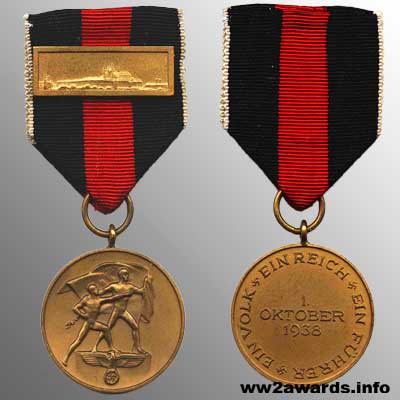
The Medal In Memory of October 1, 1938 was established on October 18, 1938; the last award ceremony took place on December 1, 1939. Since its inception, 1,162,617 people have been awarded the medal.
The medal is a circle 33 mm in diameter with a 1 mm rim. The obverse depicts an allegorical scene in which one person (symbolizing Germany) helps another person (symbolizing, in this case, the Sudetenland region of the Czech Republic) ascend a pedestal adorned with the Reich coat of arms. The obverse, featuring this scene, replicated the obverse of the medal commemorating March 13, 1938, and was later repeated on the "Recapture of Memel" medal.
The reverse of the award features the date "1 OCTOBER 1938" in the center, with an inscription around the rim that translates as "ONE PEOPLE, ONE STATE, ONE LEADER." The inscription is divided into three parts by miniature swastikas. The medal is attached to the award ribbon with a loop and ring. The ribbon is black, with a wide red stripe down the center. For those who remained after the annexation of the Sudetenland and participated in the creation of the Protectorate in Bohemia and Moravia, a bar was established, attached to the award ribbon, depicting Prague Castle.
Medal - from 30 USD; Bar - from 70 USD; Document - from 35 USD; Case – from 80 USD
In 1938, approximately 90% of the Sudetenland region was ethnic German. The population of this region of the Czech Republic believed that their rights and freedoms were being suppressed by the Slavic population of the Czech Republic, and that the lands on which they lived should be part of Germany.
In May 1938, a putsch was being prepared in the Czech Republic, and Wehrmacht troops were advancing to the Czech border to exert pressure and, if necessary, launch an offensive. However, support for the Czech Republic from France, the USSR, and even Germany's ally, Italy, prevented Hitler from implementing his plan.
The summer of 1938 saw a lull in the situation, but in September, riots and clashes between Sudeten Germans and law enforcement and troops erupted in the Sudetenland. These clashes ultimately led to the fall of the government led by Milan Goggi and the establishment of a provisional government. After several preliminary meetings throughout September, the leaders of Britain, France, Germany, and Italy held a joint summit in Munich. At 1:00 AM, Hitler, Mussolini, Daladier, and Chamberlain signed the Munich Agreement ceding the Sudetenland to Germany. Only then was the Czech delegation admitted to the negotiating room, but after reviewing the agreement, they protested. Subsequently, under pressure from France and England, who insisted on maintaining peace, the Czech delegation was forced to accept it.
After these events, nothing could stop Adolf Hitler from completely annexing the Czech Republic. In March 1939, Slovakia and Carpathian Ruthenia declared their independence and separation from the Czech Republic, and Hitler introduced his troops into the remaining Czech lands of Bohemia and Moravia, establishing a German protectorate. During the German invasion of the Czech Republic, the Reich army encountered virtually no resistance; the only battle took place in the town of Místek and lasted only about 40 minutes. A medal was established for all participants in these events, commemorating October 1, 1938, and later an additional bar for the annexation of Bohemia and Moravia.