 Awards of
World War II
Awards of
World War IIThe award was established on August 12, 1935, by order of Hermann Göring as a distinctive badge for Luftwaffe pilots.
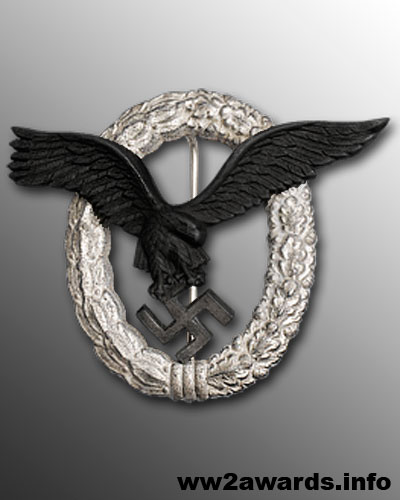
The Luftwaffe Pilot Badge was awarded to all pilots upon completion of flight training and qualification as military pilots.
Depending on the year and manufacturer, the award could be made of various alloys, including nickel-silver alloy, tombac, buntmetall, or aluminum. The production technique involved stamping, followed by hand finishing of the parts. It is designed as a wreath of oak and laurel leaves, entwined at the bottom with a ribbon. In the center of the award is an eagle with outstretched wings, holding a swastika in its talons. The eagle's wings extend beyond the perimeter of the wreath, the left wing slightly higher than the right. The wreath was made with a silver coating, the eagle and swastika with niello.
On the reverse of the award is a vertical pin for attaching the award to clothing, and the maker's mark. Well-known makers: C.E Juncker, Berlin SW; F.W Assmann & Söhne, Lüdenscheid; Berg & Nolte, Lüdenscheid; Brüder Schneider AG, Wien; W.Deumer, Lüdenscheid; Gebrüder Wegerhoff, Lüdenscheid; JMME & Sohn. Berlin; OM; In addition, there are unmarked versions issued by Friedrich Linden.
The award was presented in a blue box with the corresponding document. The size of the badge is 52 x 43 mm, with the eagle's wingspan being 65 mm.
This badge is worn on the left breast pocket, below the Iron Cross First Class.
Pilots could also order an embroidered version of the Luftwaffe Pilot badge for combat wear.