 Awards of
World War II
Awards of
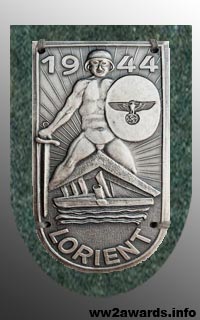
World War IIAt the end of 1944, by order of General Fehembacher, this shield was established for the soldiers holding the strategically important port city of Lorient (Lorraine - German).
In 1944, after the Allies landed in Normandy and their subsequent advance into the interior, Lorient, along with other strategically important ports, was surrounded and cut off. The Wehrmacht command decided to hold the ports for as long as possible, and the port cities were ordered to resist to the last.
Lorient was garrisoned by 26,000 troops under the command of General Fehembacher. The port city was well fortified, with numerous bunkers and underground passages, and was heavily mined. For this reason, the Allies did not dare to take Lorient by storm, but simply surrounded it and waged a battle of attrition using long-range artillery and bombardment. Fighting heroically, Lorient's defenders held out until the end of the war.
The circumstances and date of the shield's establishment are unknown, but it is known for certain that it was in late 1944. The shield itself is designed with a flat top and a round bottom. The award depicts a soldier wearing a German helmet, holding a sword in one hand and an oval shield in the other. The soldier stands on a submarine dock, from which a submarine emerges, with wavy lines representing water below. Behind the warrior are rays of the sun, along the lower edge of the shield is the inscription "Lorient" (LORRIENT) in a semicircle, and at the top is the year the port's defense began, 1944. The original design for the award did not include the German eagle and swastika, but at General Fechembacher's insistence, they were added to the shield in the warrior's hand. Since the city was surrounded, production of the shield was arranged at a local cannery and made from tin. Officers used yellowish tin, while enlisted men used steel. Unlike most other shields, the Lorient shield did not have fastening tabs; instead, four holes were made through which the shield was sewn to clothing. The tin reserves were sufficient to manufacture shields for approximately half the garrison. Later, they began to stamp out a temporary award in its place – a soldier's token with the inscription Fortress of Lorient (FESTUNG LORIENT), which was supposed to be later replaced by a full-fledged shield for Lorient, but these hopes were never destined to come true.