 Awards of
World War II
Awards of
World War IIThe Lapland Shield was the last German award in the form of a shield, as well as the last award of the Third Reich in World War II.
Official records of the establishment of the Lapland Shield have been lost, so the exact date and official award criteria remain unknown. General Franz Böhme allegedly initiated the creation of this award as early as February 1945. The exact date of its establishment remains unknown, but it was likely late April 1945. Confirmed records include entries in soldiers' service records regarding the award of the Lapland Shield to Kriegsmarine sailors on April 20, 1945.
The award documents also indicate that it was made by order of the Commander of the Land Forces in Norway, General Böhme (20th Mountain Army) and Admiral Krenck (Kriegsmarine), and not, as was usual, by order of Adolf Hitler himself. This means that the awarding of the shield was delegated to the relevant army and naval commands, which was typical at the end of the war.
The criteria for receiving this award include service for at least six months, being wounded in combat, or performing a heroic act.
Since the official documents establishing the award have been lost, a complete list of the combat actions for which this award is awarded does not exist. Regarding the Kriegsmarine, it can be said with certainty that these were actions along the northern coast of Scandinavia. Regarding the ground forces and the Air Force, these are presumably actions in the battle area of the 20th Mountain Army, simply because this area is depicted on the shield. Most likely, this refers to the battles for the Salla Fortress from July 7-8, 1941, the battles in the 20th Mountain Army's zone of operations from September 3, 1944, to October 3, 1944, the battles in Petsamo and Kirkenes between October 14, 1944, and October 23, 1944, and the battles in northern Finland from October 24, 1944, to November 7, 1944.
The awarding of the Lapland Shield was a hasty process. This is evident from the wide variety of both the award documents themselves and the shields themselves. Some award documents are printed, others are handwritten. Most award documents feature an image of a shield, although some do not. Almost all award documents are dated between July and September 1945. Furthermore, this award was produced without a swastika, and the victorious powers authorized its wear after May 9, 1945. The Lapland Shield was never mass-produced at any factory; service members received an award document with a shield design and were required to commission its manufacture themselves. A large number of awards were produced by the military themselves in prisoner-of-war camps. All this has led to a huge variety of versions of the Lapland Shield. It was produced using different dies and alloys, and today it is sometimes very difficult to distinguish an original award from a copy.
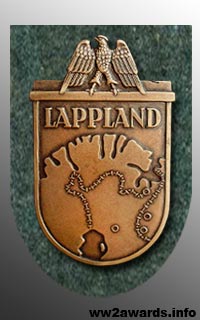
The award is designed as a shield, with a rounded bottom and a flat top. A crossbar is mounted at the top, on which sits an eagle (in the case of this award, the eagle does not have a swastika in its talons). Below the crossbar is the inscription "LAPLAND" in capital letters. Below the shield is an image of Lapland, with a schematic representation of its positions. Due to the lack of serial production, there are many variations of the award. The eagle's head is most often turned to the left, although rare examples have been found with the head turned to the right. Other elements of the Lapland Shield, such as the shape of the wings, the crossbar, the inscription, and the combat zone, can also have various differences.