 Awards of
World War II
Awards of
World War IIThe award was established in the spring of 1943 to recognize all soldiers who, despite a lack of resources, bravely fought for Kuban.
Materials:
steel, bronze coating.
Dimensions:
62*52 mm.
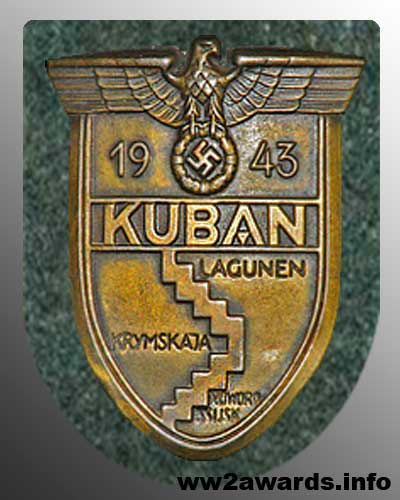
The Shield for Kuban was established on September 21, 1943. In accordance with the regulations, it was awarded to soldiers and officers of the Third Reich who defended the Kuban bridgehead in the spring and summer of 1943. The award criteria were as follows: service for at least 60 days in the Kuban bridgehead, being wounded, and participating in one of the major combat operations in the bridgehead. A separate scoring system was introduced for Luftwaffe units, based on the accumulation of points.
The award is a shield with an eagle at the top, holding a wreath surrounding a swastika in its talons. Under the eagle's right and left wings are the numbers "19" and "43," respectively. Below, separated by two lines, is the inscription "KUBAN" (Kuban). Below this is a map—a diagram of the combat zone—the Kuban bridgehead, which schematically depicts the front line with the main strategic points, from top to bottom: LAGUNEN, KRYMSKAJA, NOWOROSSIJSK.
The Kuban shield was attached to a feldgrau lining and worn, like other shields, on the upper left sleeve. A smaller version, a pin attached to the left lapel, was also issued for everyday wear. After the defeat of Nazi Germany, the award was restored in 1957, and its wearing was legalized, but only in a denazified version, which lacks the eagle and swastika.
After the encirclement and surrender of Paulus's army at Stalingrad, the Reich forces fighting in the Caucasus faced the threat of encirclement and annihilation. To avoid this, Hitler gave Army Group A permission to retreat. By the summer of 1943, the Germans, fighting their way back, were able to establish a defensive position along a specially prepared line called the Blue Line, which stretched from the Sea of Azov to the port city of Novorossiysk. Hitler demanded that the Kuban bridgehead be held, considering the situation temporary and later planning to repeat the offensive in the Caucasus.
Between April 17 and June 7, 1943, some of the largest air battles in the history of the Great Patriotic War took place in the skies over Kuban. More than two thousand aircraft participated in the battles on both sides, with some days seeing up to 50 group battles involving up to one hundred aircraft from each side. As a result of these battles, the Soviet Air Force was able to turn the tide in the air for the first time and shatter the myth of the Luftwaffe's invincibility.
During the battle for control of the Blue Line, Soviet troops managed to land troops in Novorossiysk as early as February 1943, capturing a small area of territory later known as "Little Land." Soviet troops managed to hold this small bridgehead throughout the spring and summer of 1943, after which it was expanded, and in September 1943, the entire city of Novorossiysk was liberated.
By early September 1943, due to the situation in Ukraine, Hitler ordered the evacuation of the Blue Line to the Crimean Peninsula. A commemorative award, the Kuban Shield, was created to honor all the soldiers who bravely and courageously held the Kuban bridgehead in September 1943. More than 100,000 people were awarded it.