 Awards of
World War II
Awards of
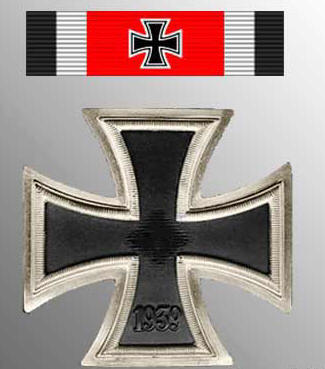
World War IIThe Prussian Iron Cross award, restored in 1939, became, by decision of Hitler, the all-German Order of the Iron Cross, which was awarded to personnel of the Wehrmacht and SS troops for completing three or more particularly dangerous and difficult missions. During World War II, more than 3 million people were awarded the first and second degrees.
Materials
Iron (black brass for the Kriegsmarine), silver (later German silver - an alloy of nickel, zinc and copper).
Dimensions
44 * 44 mm.
Awarded to
Military personnel of the German troops, SS, as well as party organizations.
Reasons for the award
For the performance of particularly dangerous missions, upon accumulation of the number corresponding to the award Points.
The award was reinstated by Adolf Hitler in 1939. The Iron Cross 1st Class became a mass award, requiring completion of up to five particularly dangerous missions and prior Iron Cross 2nd Class awards. There were also additional requirements for Luftwaffe officers—obtaining 5 points for actions in aerial combat—and for the Kriegsmarine, accumulating 50,000 tons of sunk enemy tonnage. During the war, more than 450,000 people were awarded the Iron Cross 1st Class. This award was essentially an order established by King Friedrich Wilhelm III in 1813. Hitler restored it, changing the design.
The award consisted of a three-part cross. The base was made of iron, chemically blackened to a black color; in some cases, the award was simply painted to achieve the black color. The naval version of the award, due to the iron's rapid rusting in the aggressive marine environment, was made of black brass. The award had an outer and obverse frame made of silver. The quality of the material deteriorated with each passing year of the war, and while early versions of the award could be found made of high-grade silver, by the end of the war the frame was made of zinc, in some cases not even silver-plated. On the obverse of the cross, at the center of the convergence of the rays, is a swastika, with the year "1939" on the lower ray. The reverse of the Iron Cross 1st Class is smooth and features a pin for attaching the award to clothing. Many soldiers commissioned a replica of the award for everyday wear; often, the replica was made with a screw rather than a pin, which ensured a more secure fit. The Iron Cross 1st Class is worn on the left breast pocket, or, if one is missing, in approximately the same location.
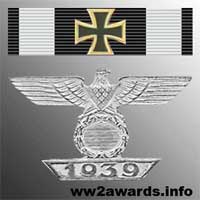
Since the Iron Cross regulations stipulated that it be awarded only for meritorious service during World War II, a clasp (shorp) was created for soldiers who received this award back in World War I. The clasp depicted an eagle with outstretched wings perched on an oak wreath with a swastika in the center. Below the wreath was a plaque with the year "1939." The clasp measured 44 x 31 mm. The clasp was worn immediately above the Iron Cross 1st Class.
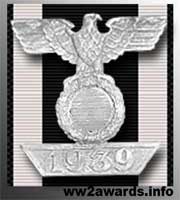
The award was restored in 1939 as a pan-German order. The Iron Cross 2nd Class became the junior award of the Order of the Iron Cross. To receive it, one had to complete three to five tasks, most often involving risk to life. The Air Force also required accumulating points for downing enemy aircraft (1 point = 1 motorized aircraft, 2 = 2-engine), while sailors had to sink enemy tonnage totaling 50,000 tons.
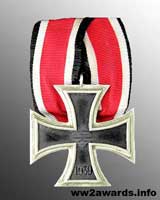
The Iron Cross 2nd Class is almost identical to the 1st Class award, with the exception of a soldered loop on the upper eyelet through which a ring for attaching the order ribbon was threaded. Unlike the 1st Class award, the reverse, like the obverse, had a black frame and the stamped "1813" on the lower arm. On dress uniforms, the award was worn on a ribbon, attached to the left side of the uniform; in the presence of other awards, it occupied the far right position. In everyday life, only the order ribbon was worn, threaded through the second button of the uniform. The ribbon's colors matched the German flag of the Third Reich, with a red stripe in the center and narrower white and black stripes at the edges.
For those awarded the Iron Cross 2nd Class during World War I, a clasp was also designed, essentially the same as the clasp for the First Class, the difference being the size 32.*31 mm. The clasp was attached to the black and white striped ribbon of the order (replicating the ribbon of the Iron Cross during the First World War), threaded through the second button of the jacket.
During World War II, the Iron Cross Second Class was awarded to more than 2.5 million people, including 39 women.
Shinkel core:
Class 1: Flat on a pin - from 700 USD; Concave on a screw - from 850 USD; Solid on a screw - from 800 USD; Round 3 - 1150 USD
Class 2: magnetic/non-magnetic - from 230 USD; Round 3 - from 300 USD
Manufacturer L/12:
Class 1: on a pin - from 750 USD; on a screw - from 800 USD
Class 2: from 400 USD
Other manufacturers and without manufacturer:
Class 1: on a pin - from 200 USD; on a screw - from 230 USD
Class 2: iron - from 70 USD non-magnetic core - from 100 USD
Sling:
Class 1 type - from 750 USD; Type 2 tombac - from 450 USD; Type 2 zinc - from 400 USD; manufacturer L/12 - from 850 USD silver - from 850 USD
Class 2 type tombac - from 350 USD; Type 1 zinc - from 300 USD; 2nd type tombac – from 200 USD; 2nd type zinc – from 170 USD; manufacturer L/12 – from 400 USD.
Documents:
Ground forces, Kriegsmarine, Luftwaffe – 1st class from 110 USD; 2nd class from 60 USD.
Submariners and parachutists – 1st class from 290 USD; 2nd class from 250 USD.
SS, missing in action, posthumous – 1st class from 450 USD; 2nd class from 350 USD.
Case: from 140 USD. Package from 50 USD.