 Awards of
World War II
Awards of
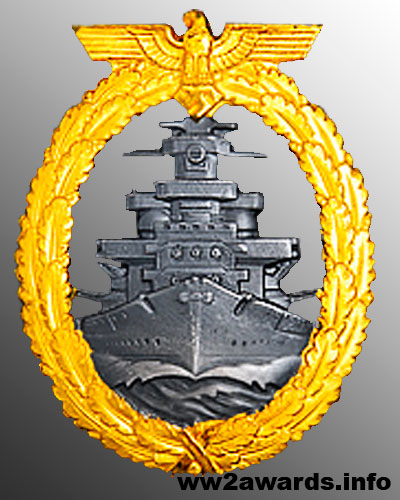
World War IIThe badge was established on April 30, 1941, for crews of the Third Reich Navy serving on battleships, cruisers, and other vessels for which no specialized badge was provided.
The criteria for the award were as follows:
- service during a combat mission for 12 weeks;
- wound received during a raid;
- success as a result of an enemy attack;
- rescue from a ship sunk during battle.
Despite the fact that the award was approved in April 1941 by order of Admiral Erich Ryder, It was also awarded for combat operations that took place before this date. Thus, in April 1942, this naval badge was awarded to all participants in Operation Weserübung, which took place from April to June 1940. In August 1942, the crews of the battleships Schleswig-Holstein and Schlesien, whose salvos began World War II on September 1, 1939, were also awarded.
The design of the badge was developed by marine artist Adolf Bock. This is how the artist recalls his work on the badge: "The badge was required for harsh naval conditions. Therefore, it had to be heavy, substantial, and warlike. This effect can be achieved by viewing a moving ship from the front, with a powerful bow wave and threatening gun barrels."
Early versions of the badge were made of brass, while later versions were made of zinc. The Navy Badge measures 57 x 44 mm and is designed as a wreath of oak leaves, topped by an imperial eagle with outstretched wings and a swastika in its talons. In the center of the badge is a battleship, bow facing the viewer, cutting through the waves.
On the reverse of the badge is a vertical pin and the manufacturer's stamp. Possible options include: Adolf Bock, Schwerin, Friedrich Orth, Rudolf Souval, Richard Simm & Sohn, B. H. Mayer Pforzheim, or Mourgeon.
This badge was worn on the left side immediately beneath the Iron Cross 1st Class or equivalent.
A version of the Navy Badge with diamonds exists, held in a private collection. However, no information exists regarding its establishment. In addition, the diamond badge was usually awarded together with the Oak Leaves to the Knight's Cross, but the only person who could have claimed this award, Admiral Theodor Krancke, claims that he did not receive such an award, and all other recipients of the Oak Leaves to the Knight's Cross were submariners.