 Awards of
World War II
Awards of
World War IIThe award was established on January 1, 1940, by order of General Brauchitsch, for officers and soldiers who took part in offensive operations but did not serve in the infantry and, therefore, were not eligible for the infantry assault badge.
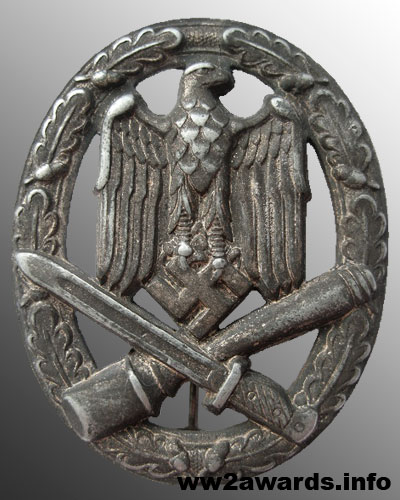
Typically, these were engineering troops, artillery, anti-tank troops, and air defense troops. This award was also given to medical personnel wounded on the battlefield. It was also awarded in some exceptional cases. For example, for the single-handed destruction of 8 enemy tanks or other armored vehicles prior to the establishment of a special breast badge for personally destroyed tanks in March 1942.
The conditions for the award were as follows:
- Not eligible for the Infantry Assault Breast Badge;
- For participation in three attacks in three separate incidents;
- For participation in three or more attacks not involving direct armed conflict in three separate incidents;
- For being wounded as a result of fulfilling the 2nd and 3rd requirements;
- For being awarded any other award as a result of fulfilling the 2nd and 3rd requirements.
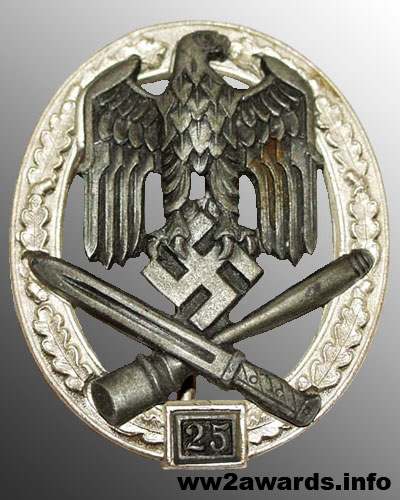
Later, the high military command faced the need to introduce a higher grade of this award, and on June 6, 1943, four new grades were approved (25th, 50th, 75th, and 100th classes).
These awards were awarded based on the same criteria as the standard award. However, priority was given to veterans who had experienced war on the Eastern Front.
In addition, the following gradation for length of service existed: eight months of service was equivalent to 10 operations, twelve months of service was equivalent to 15 operations; Fifteen months of service were equivalent to 25 operations.
The design for the badge "For Participation in General Assault Attacks" was developed by the Berlin firm of Ernst Pickhaus.
The chest badge is an oval disk measuring 53 x 42 mm and 6 mm thick. The award is framed by a wreath of oak leaves, five on each side. The lower third of the badge depicts a crossed hand grenade and bayonet. In the center is a fascist symbol—an eagle clutching a swastika in its talons.
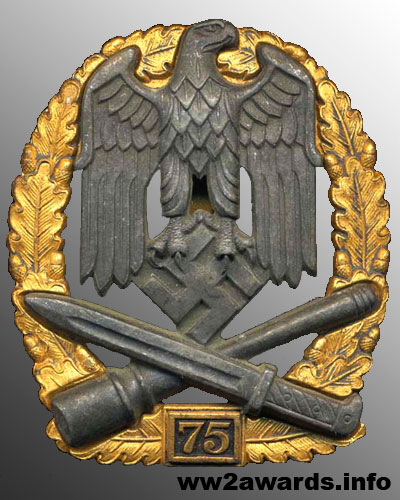
The badges of the 25th, 50th, 75th, and 100th classes were similar in style, design, and construction. This award differs from the one described above in its larger dimensions—58 x 48 mm (25th and 50th awards) and 56 x 49 mm (75th and 100th awards)—with a wreath width of 7 mm. The wreath was silver-plated for the 25th and 50th awards and gilded for the 75th and 100th awards, while the eagle and hand grenade with bayonet were blackened and executed somewhat larger. At the bottom of the wreath is a plaque measuring 10 x 8 mm, inscribed with "25," "50," "75," or "100," depending on the award's class.
All awards have a vertical pin on the reverse for attaching to clothing.
Depending on the manufacturing method, the award may be solid or hollow. However, the material used to make the badge did not always meet quality standards, resulting in the award losing its presentable appearance over time.
The award was presented in a paper or cellophane envelope indicating its designation. It was accompanied by the usual set of documents indicating the recipient's name, unit, signature, and stamp. The reason for the award was not stated. This badge was worn on the left side immediately below the Iron Cross 1st Class or similar award.