 Awards of
World War II
Awards of
World War IIThe award was established on May 30, 1941, for officers and enlisted personnel of the Kriegsmarine serving on torpedo and fast attack boats.
The criteria for the award were as follows:
- participation in at least 12 raids against enemy ships;
- wound received during combat;
- successful completion of at least one raid;
- for high professionalism.
Over the course of its existence, the badge was awarded to approximately 1,900 people.
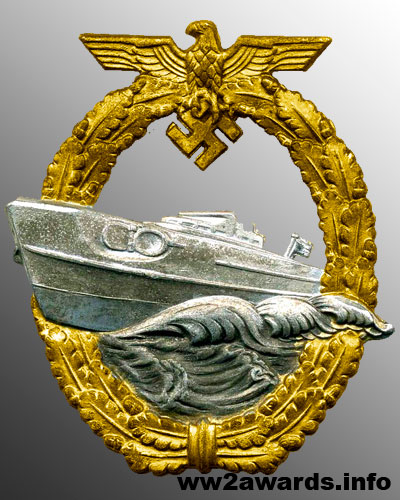
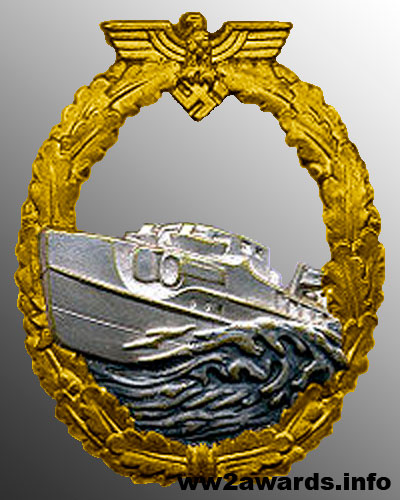
The first version of the badge was designed by Ernst Pickhaus' company in May 1941. The badge was made of zinc and was shaped like a wreath of oak leaves, entwined at the bottom with a ribbon. At the top of the wreath is an imperial eagle, with outstretched wings, holding a swastika in its talons. Both the wreath and the eagle are gold-plated. In the center of the wreath is a torpedo boat racing over stylized waves. The boat and waves are executed with a high level of detail, with the bow of the boat partially obscuring the wreath on the left side.
In January 1943, the design of the badge was partially changed. This was because the badge depicted a torpedo boat of an outdated design. In addition to the new torpedo boat design, the waves on the new badge were slightly different, and the eagle and swastika were made larger.
There was also a version of the badge with nine diamonds; only eight of these badges were awarded. The Torpedo Boat Crew Badge with diamonds was awarded to commanders previously awarded the Knight's Cross with Oak Leaves.
Also, some of the later badges from 1944-45, produced during a difficult period for Germany, were made only of zinc, without gilding.
The reverse of the award features a horizontal pin for attaching the award to clothing. This badge was worn on the left side immediately below the Iron Cross 1st Class or equivalent award.