 Awards of
World War II
Awards of
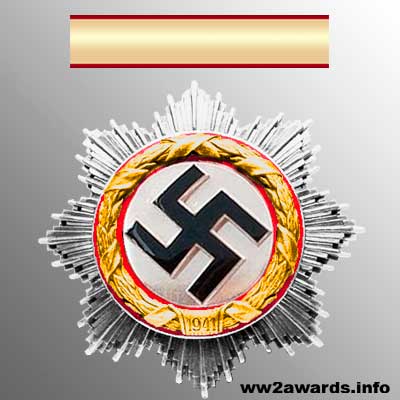
World War IIThe German Cross award, which received its second name, the Order of the Eastern Star, since it was established shortly after the outbreak of war against the USSR in 1941, became an intermediate award between the Iron Cross First Class and the Order of the Knight's Cross.
Materials
Iron, nickel, gold, silver.
Dimensions
At the widest point 63.5 mm.
Artist
Robert Klein.
To whom it is awarded
Military personnel of the German troops, SS, as well as party organizations.
Reasons for Awarding
Previously awarded the Iron Cross First Class or the War Merit Cross, and committed more than six acts worthy of the Iron Cross First Class or the War Merit Cross.
The award had two classes:
German Cross in Gold - for merits directly on the battlefield. The nominee must have been awarded the Iron Cross First Class and have committed at least six acts worthy of the Iron Cross. Since its inception, it has been awarded to 24,204 people, including 14 citizens of other countries.
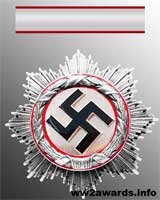
The German Cross in Silver - for actions outside of combat. To qualify for the award, one must have previously been awarded the Military Merit Cross 1st Class and have performed 6 to 12 deeds worthy of the Military Merit Cross 1st Class. During the war, 1,114 people received the German Cross "Eastern Star."
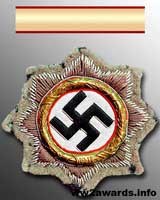
After the outbreak of war on the Eastern Front, the need arose to create an intermediate award between the Iron Cross First Class and the Knight's Cross. This award was the German Cross "Eastern Star," established in September 1941.
The award had two classes: gold and silver. Moreover, to receive the highest award, the Knight's Cross, it was not necessary to be a holder of this award, and the awards were independent of each other. To receive the gold award, it was not necessary to be a holder of the German Cross in silver.
The award was an eight-pointed star, in the center of which was a white enamel circle with a swastika. The circle was decorated with a gold (silver for the silver award) laurel wreath, at the bottom of which was the date 1941. Due to its shape and unusually large size (63.5 mm), the award was nicknamed "Hitler's fried eggs" by the troops.
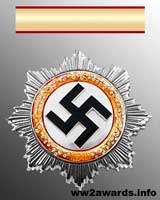
The award was uncomfortable to wear, especially for soldiers who Tankers, pilots, and submariners had to fight in the confined spaces of their vehicles, so a fabric version of the award was instituted on June 5, 1942.
In 1942, a third version of the award was created, the German Cross in gold with diamonds. This award differed from the gold version only in the presence of diamonds on the wreath. The award was intended to take its place between the Knight's Cross with Oak Leaves and the Knight's Cross. Twenty copies were manufactured, but by that time, the steadily worsening situation at the front prevented any awards from being made. Until the end of the war, the copies of the German Cross in gold with diamonds produced were kept by Dr. Doele. After the Americans captured Klesheim Castle, they were plundered by soldiers and officers, and only three copies ended up in historical museums.
German Cross in gold - from 2,000 USD
With a short pin, 6 rivets - 2,300
USD; 10 rivets - 2,500 USD; 14 rivets - 2,700 USD
Copies produced at the
front - from 900 USD
Woven version from 550 USD
Document: ground forces and Luftwaffe - from 1,000
USD; Kriegsmarine - from 1,700 USD; Parachute and submarine units – from 2,300 USD;
SS – from 4,500 USD
Case from 1,000 USD
German Cross in silver – from 2,700 USD; without manufacturer – from 2,500 USD
With a short pin, 6 rivets – 3,200 USD
; 10 rivets – 3,400 USD; 14 rivets – 3,800 USD
Copies produced at the
front – from 900 USD
Document: ground forces, Kriegsmarine, Luftwaffe – from
2,800 USD
Case from 1,300 USD