 Awards of
World War II
Awards of
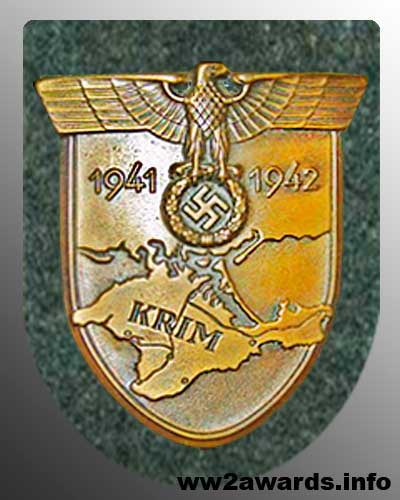
World War IIThis commemorative badge was established for all Wehrmacht servicemen who participated in the battles for the Crimean Peninsula and the assault on Sevastopol in 1941-42. The award was established on July 25, 1942 and was named the Crimean Shield.
Materials:
steel, bronze coating.
Dimensions:
62*52 mm.
The Shield for Crimea was established on July 25, 1942. The criteria for the award were participation in one of the offensive operations in Crimea, being wounded, or serving in this territory between September 21, 1941 and July 4, 1942 for at least three months. In total, more than 200,000 people, including Romanian troops, were awarded the Crimean Shield.
The award was made of sheet steel and coated with bronze paint. The award itself was made in the form of a classic shield and was attached to a cloth lining that followed its shape. The lining color was feldgrau for infantry, black for tank troops, and blue for the Luftwaffe. At the top is an eagle with outstretched wings (the eagle's wings extend slightly beyond the borders of the Crimea Shield), holding a wreath with a swastika in its talons. The shield itself features a map of southern Ukraine, including the Crimean Peninsula. The map bears the inscriptions "1941" (in the Kherson Oblast) and "1942" (in the Zaporizhzhia Oblast). On the peninsula itself, the inscription "CRIMEA" appears, along with relief images of rivers and dots marking the six largest cities (Yevpatoria, Kerch, Sevastopol, Simferopol, Feodosia, and Yalta). The shield was worn on the left sleeve; a smaller version was also created for civilian wear, attached with a pin to the left lapel.
There are two copies of the Crimean Shield made of solid gold. The first was awarded to Marshal Antonescu, who commanded the Romanian troops in the Crimean operation, and received the award from General Manstein. The second was received directly by Manstein himself.
After the war, a denazified version of the award, without the eagle and swastika, was permitted for wear.
Crimea was not included in the Barbarossa plan, but constant bomber raids on the oil fields in Ploiești forced Hitler to reconsider the strategic importance of Crimea in the war in the east.
On September 24, 1941, troops The Wehrmacht, under the command of General Manstein, supported by Romanian troops under Marshal Antonescu, launched an offensive on the Isthmus of Perekop. After a week of fighting, German forces managed to capture the isthmus and force the Soviet troops to retreat to the Ishun positions, but losses on both sides were enormous, forcing Manstein to call off the offensive.
Only by October 18th was the German army able to continue its offensive and, gradually pushing back the Red Army troops with heavy losses, began to advance deeper into Crimea. Soviet troops were forced to retreat to Sevastopol and Kerch. While the retreating troops failed to consolidate their position in the Kerch direction, and the remnants of the army were withdrawn to the Taman Peninsula, the Wehrmacht faced a problem with Sevastopol.
In 1941, Sevastopol was one of the most heavily defended places in the world, boasting minefields and numerous medium- and large-caliber guns, including two armored turret batteries with 305mm guns. The initial attack on Sevastopol was unsuccessful; German forces in Crimea were stopped, and the Soviet command meanwhile transferred the Coastal Army from Odessa.
To distract the German forces, the Soviet command landed troops in Yevpatoria. With the support of the local population and partisans, they managed to drive the Romanian soldiers out of the city, but reinforcements soon arrived and destroyed the resistance. In addition, a landing was made on the Kerch Peninsula and a Crimean front was established, but it too was defeated by the end of May 1942.
To storm the Crimean fortress of Sevastopol, the German command deployed super-heavy artillery: self-propelled Karl mortars with a 600mm barrel diameter and the 800mm Dora gun. The fire of these monsters was primarily aimed at destroying the 305mm batteries defending the city.
In December 1941, Manstein made a second attempt to take the city, but by the end of December the offensive stalled without achieving any significant success.
Only the third assault on the city in June-July 1942 was successful. Within 10 days, German troops managed to reach Sapun Mountain and take Fort BB-30, nicknamed Maxim Gorky by the German troops. Taking these positions allowed for fire to be directed at Sevastopol Bay, which placed the supply of Soviet troops in a critical situation. On the night of June 28-29, without prior artillery preparation, German troops secretly crossed the Northern Bay and attacked Soviet positions. On June 30, 1942, Malakhov Kurgan was captured, and the city's defenders were practically out of ammunition. As a result, the Soviet command tookThe decision was made to evacuate the command staff and abandon the city. Resistance was broken, and some units of the city's defenders retreated to Cape Chersonesos, where they continued fighting until July 4, after which all of Crimea came under German control.