 Awards of
World War II
Awards of
World War IIOn November 3, 1944, Hermann Göring established a new award for members of the German Air Force – the Luftwaffe Close Combat Badge.
The establishment order stated that this award was: "For courage in close combat, using small arms and close combat equipment, as well as devotion to duty."
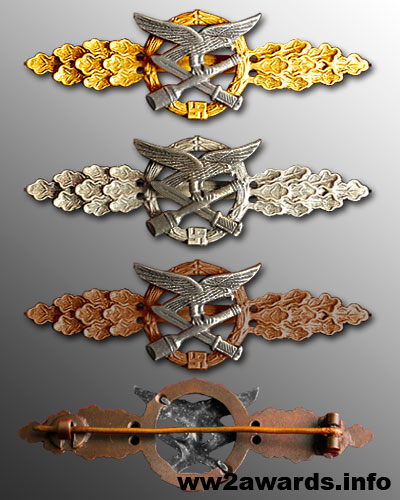
The award was established in three classes: bronze, silver, and gold. The criteria for the award were as follows:
I class - bronze, for 15 days of close combat, (10 days in case of a seriously wounded candidate);
II class - silver, for 30 days of close combat, (20 days in case of a seriously wounded);
III class - gold, for 50 days of close combat, (40 days in case of a seriously wounded).
Also, the Close Combat Clasp for the Luftwaffe could be obtained by accumulating days of service, as follows:
Eight months of service, equivalent to five days of close combat;
Twelve months of service, equivalent to ten days of close combat;
Fifteen days of service, equivalent to fifteen days of close combat.
The following services were taken into account for the award:
On the Eastern Front - after June 22, 1941;
In Africa – after March 26, 1943.
A recipient of the Gold Class of the award also received twenty-one days of leave, which was an exceptional luxury in the fifth year of the war.
If a Luftwaffe soldier had previously been awarded the Hand-to-Hand Combat Badge for the ground forces, he had the right to exchange it for a similar class for the Luftwaffe.
From March 26, 1944, Adolf Hitler asserted the exclusive right to award the Close Combat Clasp, 1st Class.
No data on the number of those awarded has survived.
The award is made in the form of a wreath of laurel leaves, the lower part of which is covered A swastika. In the center of the wreath is an eagle, its wingtips extending beyond the wreath's border, holding a crossed bayonet and hand grenade in its talons. Nine oak leaves extend from the wreath to the right and left. On the reverse of the award is a horizontal pin for attaching it to clothing, and a manufacturer's stamp may be present.
The wreath and oak leaves vary in material depending on the award version (bronze, silver, or gold). The eagle and crossed bayonet and hand grenade are always made of oxidized silver.
The award's dimensions may vary depending on the manufacturer, from 95 x 25 mm to 97.5 x 27 mm.
Only the highest class of the award is worn. The award is worn above the left breast pocket, and if equipped with an award bar, it is worn 1 cm above it.