 Awards of
World War II
Awards of
World War IIThe badge was established on November 25, 1942, as an award for soldiers and officers of the Third Reich who participated in hand-to-hand combat.
The award was established by personal order of Hitler. Since the criteria for receiving it differed significantly from those for other awards, it can be said that it was truly a separate award, not a duplicate of the Infantryman's Breast Badge.
The term "hand-to-hand" referred to combat in which the opposing sides used close-combat weapons such as knives, bayonets, or hand grenades.
The starting point on the Eastern Front was considered to be June 22, 1941, and on the African continent, March 26, 1943.
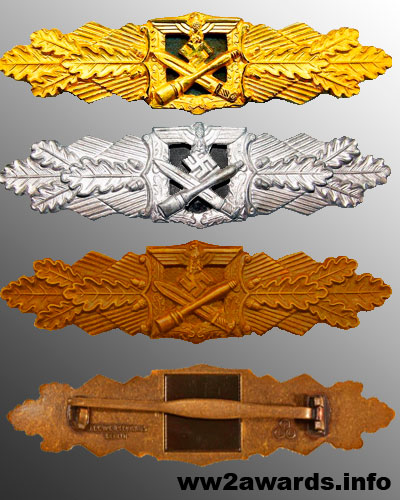
There were three degrees of this award: "bronze," "silver," and "gold." The "Bronze" version of the award was awarded for participation in hand-to-hand combat for 15 days, Silver for 30 days, and Gold for 50 days.
Furthermore, a gradation of service time was introduced: 8 months of service was equivalent to 5 battles; 12 months to 10 battles; 15 months to 15 battles.
The award could be presented posthumously to the relatives of the deceased. Division command also had the right to nominate wounded soldiers who, due to injuries, were unable to serve the required period of service. In this case, the criteria were as follows: Bronze - 10 days; Silver - 20 days; Gold - minimum 40 days.
The "For Participation in Close Combat" breast badge was also awarded in Luftwaffe units, although it was later replaced by the "For Participation in Close Combat of the Luftwaffe" breast badge.
According to available information, approximately 600 people were awarded the highest Gold version of the award. Among the first were Hitler, Himmler, and Guderian. On March 26, 1944, Hitler declared his unconditional right to assign and award the "Golden" version of the "For Participation in Hand-to-Hand Combat" badge.
The design was developed by the Wilhelm Pickhaus firm in Berlin. The breast badge was made of zinc, although aluminum examples were also available; the gold version of the award was made of tombac. In the center is a quadrangle, the upper edge of which is covered by the outstretched wings of an eagle holding a slingshot in its talons. Below is a crossed bayonet and hand grenade. The remaining edges of the quadrangle are covered with oak leaves. Rays extend from the rectangle on either side, each covered by four oak leaves, with two acorns at the base of each leaf.
On the reverse is a horizontal pin for attaching to clothing. The badge was worn on the left side, 1 cm above the breast pocket. If multiple degrees of the award were awarded, the highest degree was worn.
The award's dimensions varied slightly depending on the manufacturer: its width ranged from 95 to 97.5 mm, and its height from 25 to 27 mm.
The award was issued in a cardboard case, with the award's name written in Gothic letters on the front. The gold version was presented in a very beautiful and expensive case.
The usual set of documents (an entry in a soldier's book) was included, indicating the recipient's name, unit name, signature, and stamp.