 Awards of
World War II
Awards of
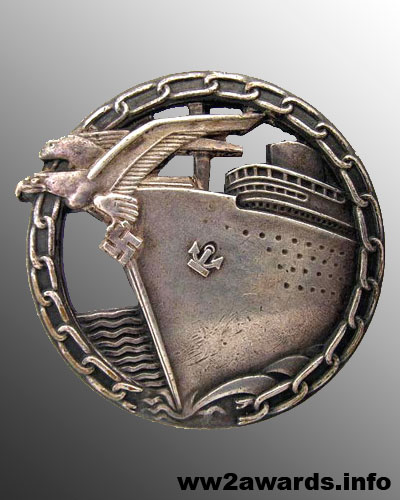
World War IIThe award was established on April 1, 1940, for officers and sailors of the Kriegsmarine whose service on warships or transport ships led to the breaking of the naval blockade of Germany.
The criteria for receiving the award were as follows:
- For skillful leadership;
- For breaking the blockade and unblocking the docks of German ports;
- For being on a ship that has lost control due to an enemy attack;
- For being wounded during combat at sea;
- For sinking one's own ship in order to avoid its capture by the enemy;
- For causing damage to an enemy ship;
- For any action to prevent capture German ship.
A half-scale replica of this badge was awarded to civilians and crew members of merchant ships. The award was also available to crews of ships chartered by Germany, as well as sailors of warships from Germany's allies; the criteria for awarding were the same as for German sailors.
The first award ceremony took place on July 1, 1941, to the crews of the Hugo Ohlendorf and Helena. A total of approximately 1,700 awards were issued over the course of its existence.
The design of the award was developed by Otto Placzek.
The badge was made of zinc and was an oval measuring 48 x 49 mm. In the center of the badge was a ship, with an eagle holding a swastika in its talons on its bow. Along the edge of the badge is an anchor chain, broken at the bottom by the ship's bow.
The reverse of the award is flat and has a vertical pin for attaching to the jacket. The manufacturer's name is indicated at the bottom of the badge.
The "Blockade of the Breakthrough of the Naval Blockade" badge is worn on the left side immediately below the Iron Cross 1st Class or equivalent award.