 Awards of
World War II
Awards of
World War IIThe badge was established on January 30, 1944, as an award for personnel of field units of the Wehrmacht, Luftwaffe, Kriegsmarine, SS, police, and SD who participated in anti-partisan operations.
In early 1941, partisan warfare against the invaders began to unfold in several European countries (Yugoslavia, Poland) occupied by Nazi Germany. In attempting to suppress the resistance of these rebel units, German troops faced a rather serious problem: they were unprepared for this form of warfare.
Initially, Wehrmacht field units operated against irregular partisan formations, adhering to army regulations, but it soon became clear that new tactics were needed. The partisans operated in small groups, hiding in inaccessible forests and mountainous terrain, and sometimes simply blended into the civilian population.
In October 1942, overall command of the anti-partisan struggle passed to the Waffen SS. By February 1944, a representative of Heinrich Himmler's department had been appointed in each military administrative zone.
In 1944, the Resistance movement swept across virtually all of Europe – from the western territories of the USSR to the Mediterranean coast of Italy and France. Partisans sometimes created truly serious problems for the normal functioning of the Axis rear services, destroying lines of communication (railways, bridges, communication centers, etc.). Large and well-armed detachments attacked garrisons and even military units.
All branches of the German military, including the Luftwaffe and Kriegsmarine (coastal defense units), began to participate in anti-partisan operations, although the primary role was still assigned to the field gendarmerie and police units, the SS troops, and the State Security Service (SD).
Punitive operations carried out against the partisans were distinguished by their particular brutality. The Germans treated resistance fighters as common bandits, so captured partisans faced only death—shooting or hanging. This, in turn, provoked a counter-reaction from the partisans, who had nothing to lose. For a German soldier or officer captured by partisans, the anti-partisan badge could cost him his life, so Germans in the field (especially towards the end of the war) were reluctant to attach it to their uniforms.
In January 1944, the "For the Fight against Partisans" badge was developed. The main criteria for the award were personally developed by SS Chief Heinrich Himmler.
They were based on a cumulative system:
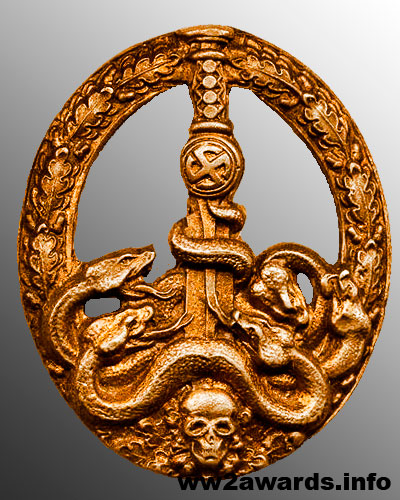
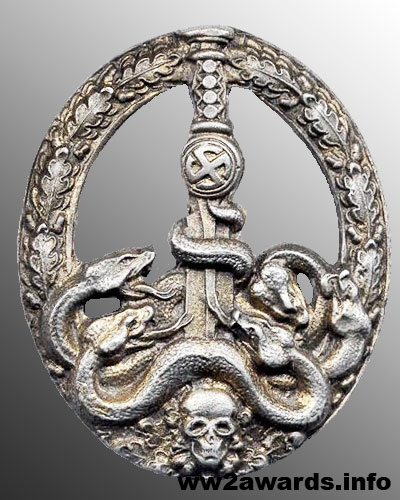
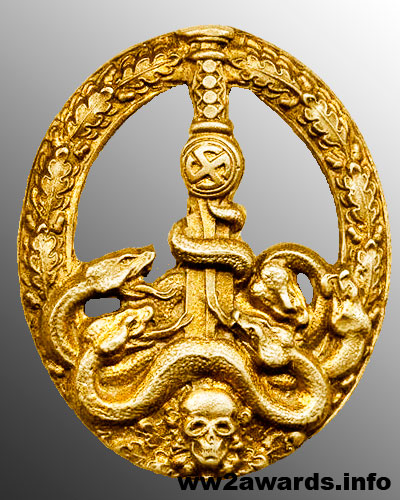
Ground forces - 20 days of combat participation entitled one to a bronze badge; 50 days - a silver badge; and 100 days - a gold badge.
For the Luftwaffe, respectively - 30, 75, and 150 combat sorties directly related to anti-partisan operations. If an aircraft was shot down, three sorties were counted.
A higher-grade award—a gold badge with diamonds—was designed, but only one person received it: Himmler.
The artistic execution of the award was very striking. The central composition featured a skull and crossbones, pierced by a sword with a swastika on the blade. The blade of the sword was wrapped in a Hydra—a mythological five-headed snake symbolizing the "countless" partisan "gangs" (in ancient Greek myths, the Hydra's severed head would be replaced by a new one). The entire composition was framed by a wreath of oak leaves.
The badge was made of zinc, and was available in two versions: solid metal and hollow. There were variations of hollow badges with large and small pins, with various clasp systems. On some badges, the snake heads were poorly rendered.
On the reverse, the award has a vertical pin for attaching to clothing. The badge is worn on the left side, immediately below the Iron Cross 1st Class or equivalent.
The award was presented in a dark green velvet-lined box with a white satin lid.