 Awards of
World War II
Awards of
World War IIThe award was conceived in April 1944 for sailors of small vessels fighting under the command of Rear Admiral Heye. By small vessels, this meant ultra-small submarines of the Neger, Biber, and Molch types. In addition, sailors of Sprengboote-class surface boats, which, loaded with dynamite, were sent directly to their targets, could also receive this award. These boats were not operated by suicide boats; the operator was intended to jump overboard immediately before impact and then be rescued by the control vessel.
Other awards:
Luftwaffe Pilot Badge an award for pilots who have completed flight training and received the qualifications of a military pilot and Pilot Badge Glider pilot..
On November 30, 1944, this award was instituted by Grand Admiral Karl Dönitz in seven classes. The first four classes were embroidered, while classes 5-7 were bronze, silver, and gold, respectively.
The first class was awarded for minor achievements, such as participation in planning combat operations. The second class was awarded for participation in a single combat sortie, the third class for a second combat operation, and the fourth for a third. A bronze badge was awarded for participation in four combat operations, a silver badge for seven combat sorties, and a gold badge for ten or more combat sorties.
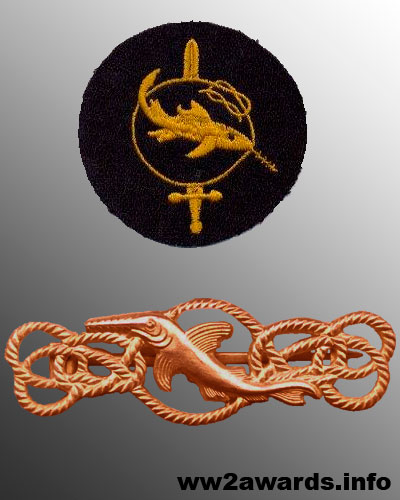
The design of the awards was developed by Otfried Neubecker. The first four classes were embroidered with yellow thread on a blue wool circle. Classes 5-7 were made of metal with a corresponding coating.
The first class award is embroidered in the form of a rope encircling a sawfish, with a loop at the top, the tail and nose of the sawfish extending beyond the loop. The second class award is distinguished by the presence of a sword, the hilt and tip of which extend from under the loop. The third class award features two crossed swords, and the fourth class award features three.
The fifth, sixth, and seventh class awards were crafted in the form of a figuratively arranged rope with a sawfish placed on it. The reverse of the award features a horizontal clasp for attaching to clothing. On the original award, unlike most counterfeits and post-war copies, the fish's fins are smooth, without webbing.
The small boat and dinghy badge is worn on the left chest, above the breast pocket of the tunic.
It is unknown how many metal awards were issued, nor is it known whether anyone was awarded the two highest classes of the award, or whether they were ever issued. Only one sale of an original version of the award is known to have occurred in Hamburg in 1998; all other advertisements for sale turn out to be post-war copies or fakes.