 Awards of
World War II
Awards of
World War IIBy the time the war in the east began, the awards system of Nazi Germany did not include any awards that could be given to residents of the Slavic and Caucasian peoples who provided direct or indirect assistance to the Reich troops. The Iron Cross and War Merit Cross regulations did not allow this, but initially, they either turned a blind eye and awarded them anyway, or issued fictitious local awards that had no official status.
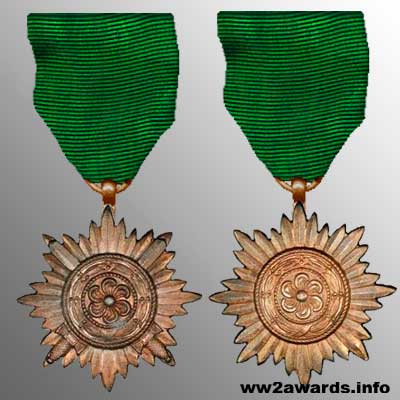
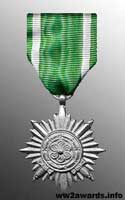
It wasn't until July 1942 that an award for bravery (with swords) and merit (without swords) was established for the Eastern Peoples. According to the award's statutes, it was intended to be awarded to military personnel and civilians who participated in the war on the side of the Reich (ROA, UPA, Turkestan battalions, Cossack units, law enforcement agencies, local police battalions, etc.). In May 1943, the award's statutes were amended, allowing it to be awarded to German soldiers and officers serving in these units.
According to its statutes, the Eastern Peoples' Order for Bravery was in many ways similar to the Iron Cross, and was awarded for heroic deeds and other courageous acts committed in direct confrontation with enemy forces. The Order for Courage, 1st Class in Silver, was equivalent to the Iron Cross, 1st Class, and the Order for Courage, 2nd Class in Silver, to the Iron Cross, 2nd Class.
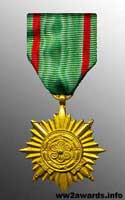
The Order for Eastern Peoples for Merit is similar in statute to the Military Merit Cross. It was awarded for assistance to the army without direct confrontation with the enemy, as well as for maintaining order in occupied territories.
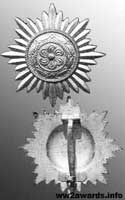
Both awards had five degrees, divided into two classes. The 2nd class award for Eastern peoples had three classes: bronze, silver, and gold; the 1st class was awarded only in gold and silver.
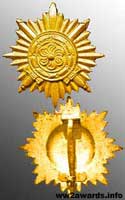
Since the award was intended to be given to people of different nationalities and religions, it had a bland appearance and obscure symbolism. The 2nd class award for Eastern peoples had a diameter of 40 mm and was made in the form of an eight-pointed star, on which was placed a medallion with a six-petaled flower in the center, framed by a wreath of laurel leaves. For the "bravery" award, two crossed swords, points up, are placed beneath the medallion. A ring for attaching the medal to the ribbon bar is soldered to the upper arm of the eight-pointed star. All awards were made of zinc and were plated accordingly: bronze, silver, or gold. In everyday life, only the order ribbon, threaded through the second buttonhole of the suit, was permitted to be worn instead of the award.
The Third Reich award for Eastern Peoples, 1st Class, was slightly larger – 48 mm. It differed from the 2nd Class in that it was worn on a pin on the left breast pocket, similar to the Iron Cross, 1st Class.
According to the award regulations, each class of the 2nd Class medal for Eastern Peoples was awarded three times before a given individual was awarded the next class. So, to receive a 2nd class award in gold, the recipient by that time had to have received 3 awards in bronze and 3 awards in silver.