 Awards of
World War II
Awards of
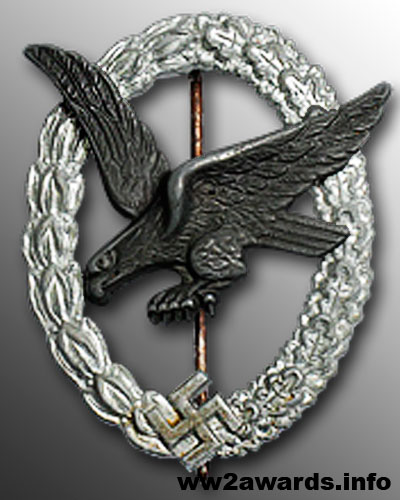
World War IIThe award was established by Luftwaffe Supreme Commander Hermann Göring on June 22, 1942, for gunners and flight mechanics of the German Air Force.
The criteria for the award were as follows:
- two months of service in the auxiliary flight;
- at least 5 combat sorties;
- sustaining a combat wound.
The award was separated from the more general gunners and radio operators' badge. After its establishment, radio operators continued to receive the old version of the award, while gunners and flight mechanics received the new one. It differed from the previous badge by the absence of lightning bolts in the eagle's talons.
Other awards:
Luftwaffe Tank Attack Badge, an award created to replace the Tank Attack Badge for ground forces and the Order of the Roman Eagle.
The award was made in the form of a wreath of oak and laurel leaves, covered at the bottom by a swastika. In the center of the wreath was a diving eagle, executed in blackened finish. Early examples of the badge were made of tombac, while later ones were made of zinc, aluminum, or butt metal.
The reverse of the award features a vertical pin and possibly a maker's mark stamped on the reverse of the eagle. Known makers include: F.W Assmann & Söhne, Lüdenscheid; C.E Juncker, Berlin SW; JMME & Sohn, Berlin; W.Deumer, Lüdenscheid; Berg & Nolte, Lüdenscheid; Brüder Schneider AG, Vienna. There are also early versions of the award, where the eagle was originally crafted with lightning bolts, which were later removed, but a trace of their removal remains.
Badge dimensions: wreath height from 53.5 to 52 mm, width from 43.5 to 39.8 mm, eagle wingspan from 43.1 to 40.4 mm.
The badge was presented in a blue box, embossed in silver thread in three lines: Fliegerschutzenabzeichen / fur Bordshutzen / und Bordmechaniker. A sewn version of the badge also exists.
The Riflemen and Flight Mechanics badge was worn on the left breast pocket of the uniform, beneath the Iron Cross 1st Class.