 Awards of
World War II
Awards of
World War IIThe Foreign Theater of Operations War Cross (French: Croix de guerre des théâtres d'opérations extérieurs) is a French military decoration established on April 30, 1921.
World War I ended on November 11, 1918, but French troops continued to fight in many theaters outside France: Syria, Palestine, Morocco, and West and Equatorial Africa.
The award was established on April 30, 1921, as an analogue of the 1914-1918 War Cross, the difference being that this award was awarded exclusively for actions as part of expeditionary forces outside France, in the period after November 1918.
To date, the following theaters have been identified for which this award can be presented:
Lebanon 1918-1920;
Morocco 1918;
Indochina 1918-1922;
Equatorial Africa 1919;
West Africa 1918-1921;
Morocco 1921-1926;
Indochina 1945-1954;
Baltic countries, Upper Silesia, Poland, Czechoslovakia, USSR, Hungary and Romania 1939-1945;
Madagascar 1947;
Korea 1950-1953; Egypt 1956; Persian Gulf 1991-1992; Yugoslavia 1999.
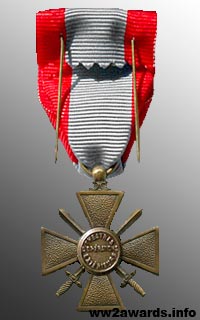
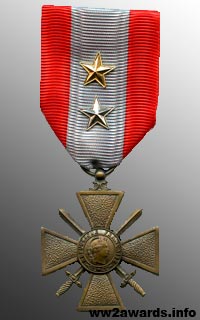
The award is made of bronze, in the form of a Patte cross with sides measuring 37 mm. At the intersection of the rays are two crossed swords, points upward. The design was created by the sculptor Paul-Albert Bertholme. The obverse features a medallion depicting the head of Marianne (the national symbol of the French Republic) in a laurel wreath. Around the edge of the medallion is the inscription "RÉPUBLIQUE FRANÇAISE" (French Republic). On the reverse, within the medallion is the inscription "THÉÂTRES D'OPÉRATIONS EXTÉRIEURS" or "TOE" (theater of military operations).
The cross is suspended from a 38 mm wide gray moiré ribbon through a ring, with 10 mm wide red stripes along the edges. A star or palm branch is always attached to the award ribbon, indicating the achievement for which the award is presented.
The criteria are similar to those for the Military Cross of 1914-1918 and 1939-1945:
a bronze star - for those who were mentioned in a dispatch at the regiment or brigade level;
a silver star - for those who were mentioned at the division level;
a gilded silver star - for those who were mentioned at the corps level;
a bronze laurel branch - for those who were mentioned at the army level;
a silver laurel branch - replaces five bronze ones.
The Military Cross is worn on the left side of the chest and, if other awards are present, is placed after the Military Cross of 1939-1945.