 Awards of
World War II
Awards of
World War II
The French government-in-exile needed to reward volunteers fighting for the liberation of France, both peacefully and on the battlefield. But the problem was that France's highest award, the Legion of Honor, along with all its documentation, had ended up in occupied Paris, making it impossible to award.
On November 16, 1940, Order No. 7 established a new award – the Order of Liberation (of France), which could be awarded to both military personnel and civilians who made a significant contribution to the liberation of the country from the occupiers. In the original version of the statute, members of the order were to be called "Crusaders of Liberation," but in the final version, this term was replaced with "Brothers of Liberation." According to the statutes, the head of the order is the Grand Master of the order, the first of whom was Charles de Gaulle.
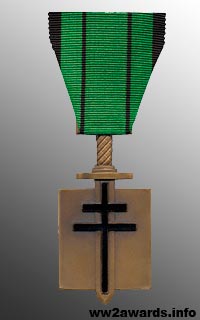
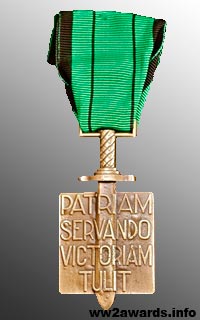
The award is made of bronze, in the form of a rectangular shield with sides of 33 x 30 mm. The shield is divided into two parts by a sword measuring 59 x 7 mm. On the obverse, at the top, is the Cross of Lorraine, the symbol of Lorraine, covered in black enamel. The reverse bears the Latin inscription PATRIAM SERVANDO VICTORIAM TULIT (Loyal to the Fatherland, Victory Will Befall).
The award ribbon is green (symbolizing hope) with black stripes (symbolizing sorrow). Initially, the stripes were diagonal, but in 1942, the award ribbon acquired its final design, with two wide black stripes at the edges and two narrow stripes closer to the center.
In addition, a chain of the order was made for the Grand Master, consisting of 10 crosses of Lorraine, covered in green enamel and connected by rings. Attached to the chain is a medallion representing the insignia of the order, with sunbeams radiating from beneath it. The medallion is attached to the chain via a pendant shaped like a ribbon bearing the order's motto and two crossed swords.
During World War II, 1,036 people were awarded the Order of Liberation, 271 of whom were posthumous.