 Awards of
World War II
Awards of
World War IIEstablished by Louis Bonaparte (Napoleon III) on January 22, 1852, to reward non-commissioned officers, corporals, police officers, soldiers, and sailors for their impeccable service and bravery, the Military Medal became the second-highest award in France, after the Legion of Honor.
The future Emperor Napoleon III sought to secure the loyalty and favor of the army, as well as partially restore justice in the awarding of military awards, since the Legion of Honor, originally created as an award for any citizen regardless of rank, eventually became an award exclusively for officers in the army.
The first award ceremony took place on March 21, 1852, at the Tuileries Palace. Louis Bonaparte himself presented the award to 48 ordinary soldiers of the Parisian army.
The award sparked considerable controversy in society, based on the separation of the Military Medal from the Legion of Honor based on military rank, as both soldiers and officers shed the same red blood on the battlefield. This led to changes in the award's regulations; it could now be awarded to officers as well, although the awarding of officers was not widespread; during the Second Empire (1852-1870), only 47 senior officers were awarded it.
The awarding of the medal was particularly widespread during World War II; approximately 232,000 people were awarded the medal for their actions during these years.
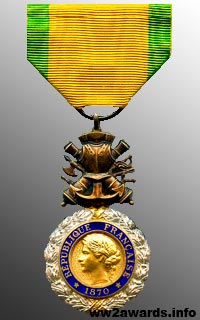
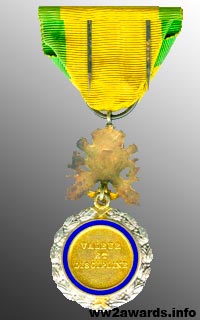
Over the years, the award underwent several changes, and by the beginning of World War II, it had the following appearance. The Military Medal is 36 mm in diameter and is made of gilded silver. In the center of the award is a medallion with Marianne's profile, surrounded by a blue rim with the inscription "REPUBLIQUE FRANCAISE *1870*" (French Republic 1870). Later, in 1951, the numerals "1870" were replaced with a five-pointed star. A silver laurel wreath surrounds the medallion. The reverse of the award is decorated with the inscription "VALEUR ET DISCIPLINE" (Valor and Discipline).
The award is attached to a yellow ribbon with green stripes at the edges via a pendant. The pendant is designed in the form of military paraphernalia and consists of two crossed cannons, armor, a halberd, a sabre, an anchor, and pistols.