 Awards of
World War II
Awards of
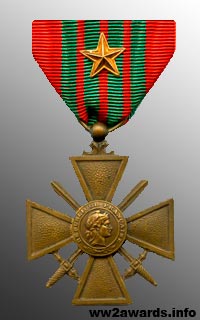
World War IIThe Croix de Guerre 1939-1945 is a French military decoration, established on September 26, 1939, for all who fought on the side of the Allies against the Axis forces at any time during World War II.
Due to the large theater of war, the criteria for awarding this award are also quite extensive:
- those who fought during the Battle of France;
- those who fought in the underground and resistance forces during the occupation;
- those who fought on the side of the government in exile;
- those who fought on the Western Front;
- those who Fought in the Middle East theater;
- those who fought in the Mediterranean theater;
- those who fought in the African campaign.
The Croix de Guerre 1939-1945 was designed by sculptor Paul-Albert Bertholm. It is designed as a 37mm cross pattée, with two crossed swords passing through the center. At the center, on the obverse, is the symbol of the French Republic—the profile of Marianne, surrounded by the inscription "République française" (French Republic). On the reverse side is the date 1939-1940 (early awards awarded during the defense of France), 1939-1945 (later awards awarded following the results of World War II), or the year of award 1942 (awards awarded during World War II, in the period 1940-45).
The award is attached to a red moiré ribbon with 4 longitudinal green stripes.
The award ribbon must have a clasp in the form of an olive branch or star, made of bronze, silver, or gilded silver, in six possible combinations:
Bronze star - for those who were mentioned in the dispatch at the regiment or brigade level;
Silver star - for those who were mentioned at the division level;
Gilded silver star - for those who were mentioned at the corps level;
a bronze laurel branch - for those who were mentioned at the army level;
a silver laurel branch - replaces five bronze ones;
a silver-gilt laurel branch - for those who were mentioned in dispatches of the Free French forces (the Government in Exile during World War II).
The total number of clasps on the ribbon is unlimited.
In terms of its status, depending on the clasps, it was equivalent to the American awards Bronze Star and Silver Star, and the British awards Military Cross and Military Medal.