 Awards of
World War II
Awards of
World War IIThe French Resistance Medal is an award established by the Committee of National Liberation, based in Great Britain, during World War II.
The award was established by decree of General Charles de Gaulle on February 9, 1943, "to recognize extraordinary acts of faith and courage, both in France and in the territories of the Empire abroad, for those who contributed to the resistance of the French people against the occupiers and their allies, beginning on June 18, 1940."
Furthermore, this award could be revoked, after it was awarded, if actions were found to defame honor and dignity, regardless of whether they were committed before or after the award of the medal.
For Over the years of its existence, the Resistance Medal was awarded to 62,751 people, 24,463 of whom were posthumously. It was also awarded to 18 communities, 21 military units, and 15 organizations (monasteries, schools, hospitals) that particularly distinguished themselves during the struggle.
The medal was awarded until March 31, 1947, and for events in Indochina until December 31, 1947.
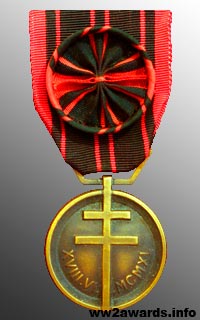
The award is made of bronze and has a diameter of 37 mm. The obverse is slightly convex, with a relief image of the Cross of Lorraine running across the entire medal. Along the lower edge is a semicircular inscription in Roman numerals: "XVIII.VI.MCMXL" (June 18, 1940), the date on which General Charles de Gaulle delivered his famous appeal on BBC radio.
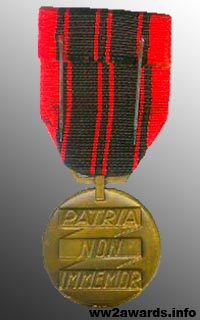
On the reverse, three bars bear the Latin inscription "PATRIA NON IMMEMOR" (THE NATION DOES NOT FORGET). The pendant, a diamond-shaped pendant extending from the upper edge of the cross, is an integral part of the medal.
The pendant is attached to a black silk moiré ribbon with six vertical red stripes. The ribbon is 36 mm wide, with 3 mm wide stripes at the edges, a 1 mm wide stripe 5 mm from the edge, and two 1 mm wide stripes in the center, spaced 6 mm apart.
When an officer is awarded the Resistance Medal, a rosette in the ribbon's colors, 28 mm in diameter, is attached to the award ribbon.