 Awards of
World War II
Awards of
World War IIThe Commemorative Medal of the War of 1939-1945 (French: "Médaille commémorative de la guerre 1939–1945") is a French commemorative award established on May 21, 1946, to recognize all those who personally participated in World War II.
According to the award's statutes, it was awarded to all military personnel who served in the French military from 1939 to 1945, were present on warships or armed merchant ships, as well as other French citizens who took part in the war against the Axis forces and their allies, and foreign nationals who served in the military France. In 1949, amendments were made to the regulations, allowing resistance members who did not engage in direct combat with the enemy to receive this award.
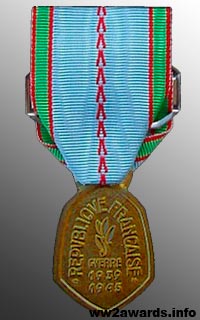
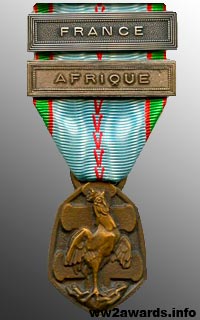
The award is made of bronze and has a hexagonal shape. The width of the medal is 28 mm, the height 38 mm. The obverse depicts a rooster with outspread wings, standing on a broken chain, superimposed on the Cross of Lorraine. On the reverse, along the top edge, is the inscription "RÉPUBLIQUE FRANÇAISE" (French Republic), with a laurel branch in the center, and below it the three-line inscription "GUERRE 1939 1945" (War 1939 1945).
The medal is attached to a 36mm wide silk moiré ribbon via a loop that is integral with the medal. The ribbon is light blue, with 3mm green stripes on either side, bordered by 1mm red stripes. In the center of the ribbon is a row of vertical red "V"s, standing for Victory.
One or more bars/clasps are attached to the award ribbon, specifying for what actions the award was received:
FRANCE (France) for operations between September 3, 1939 and June 25, 1940;
NORVÈGE (Norway) for operations between April 12, 1940 and June 17, 1940;
AFRIQUE (Africa) for operations between June 25, 1940 and May 13, 1943;
LIBÉRATION (Liberation) for operations in Corsica or in the French campaign between June 25, 1940 and May 8, 1945;
ALLEMAGNE (Germany) for operations between September 14, 1944 and May 8, 1945;
EXTRÊME-ORIENT (Far East) for operations (including in the Indian and Pacific Oceans) between 7 December 1941 and 15 August 1945;
GRANDE-BRETAGNE (United Kingdom) for operations between 25 June 1940 and 8 May 1945;
URSS (USSR) for operations of the Normandie-Niemen fighter air regiment between 28 November 1942 and 8 May 1945;
ATLANTIQUE (Atlantic) for naval operations between 3 September 1939 and 8 May 1945;
MANCHE (English Channel) for naval operations between 3 September 1939 and 8 May 1945;
MER DU NORD (North Sea) for naval operations between 3 September 1939 and 8 May 1945;
MÉDITERRANÉE (Mediterranean Sea) for naval operations between 3 September 1939 and 8 May 1945;
ITALIE (Italy) was abolished in 1953 following the creation of the Italian Campaign Medal.
Another seven bars with the years "1939", "1940", "1941", "1942", "1943", "1944" and "1945" are attached to the ribbon if the medal is awarded for events that occurred outside the above-mentioned theaters of combat, or if these actions do not fall under the date criterion established for the theater of combat bar.
In addition, there are two more bars for the Commemorative Medal of the War of 1939-1945 years:
Passive Defense (Passive Defense) for those who were disabled or otherwise injured while fighting fires from bombings and clearing rubble. (supplement to the charter of August 2, 1949).
Volunteer (Volunteer) for those, who can prove that he voluntarily enlisted in the service in 1939-1945.