 Awards of
World War II
Awards of
World War IIThe Cross of the Volunteers of the Resistance (French: "Croix du combattant volontaire de la Résistance") is a French decoration awarded, as the name suggests, to those who fought in the resistance, were deported or interned for resistance actions, or were wounded or killed in the course of these actions.
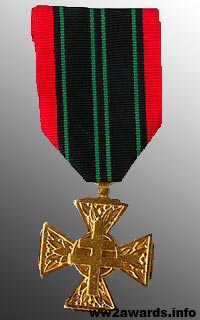
The Cross of the Volunteers of the Resistance was established in 1954. The criteria for the award were taken from the Resistance Fighter Certificate, established in 1949, and were as follows:
Resisted deportation or internment;
Killed, wounded, or executed for resistance actions;
Was a member of the resistance and participated in resistance battles for at least 90 days in the French Resistance forces (FFC), the French Troops of the Interior (FFI), or the Internal Resistance Troops (RFI);
Persons whose participation in active resistance activities for at least 90 days can be confirmed by at least two people known for their activity in the French Resistance.
Receipt of the Cross of the Volunteers of the Resistance is taken into account when considering an application for the Cross of the Volunteers of the 1939-45, and for the title of Chevalier of the Legion of Honor (under the quota reserved for the Resistance).
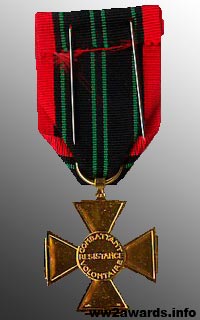
The design of the cross was created by Frederic de Vernon, the award is made of bronze, in the form of a cross Patte with sides 36mm. The obverse of the award features the Cross of Lorraine, the arms of which are decorated with raised laurel leaves. On the reverse, in the center, is a medallion with the inscription "Combatant volontaire résistance" (Resistance volunteer), the arms of the cross are smooth. The award is attached to a 36mm-wide black silk moiré ribbon with a ring. Along the edges of the ribbon are two red stripes, each 3mm wide, followed by four green stripes, each 1mm wide, the first 5mm from the edge and the second 2mm from the center.